Crystal uhd vs qled – which samsung technology is better?
If you’re searching for a top-shelf LED TV right now, you’ve probably run into Samsung’s product catalog quite a few times.
The tech giant makes some of the best panels on the market in various sizes and price ranges. All of the models you’ll find belong to a specific category, and the most popular categories from Samsung are QLED, Neo QLED, and Crystal UHD.
In this article, we will look at Crystal UHD vs QLED – Samsung’s standard and premium TVs.
Crystal UHD vs QLED – an introduction
Crystal UHD is Samsung’s brand name for standard 4K TVs. So, rather than being an innovative panel technology, Crystal UHD simply stands for “Ultra HD,” or anything above 3840×2160 pixels (4K).
Crystal UHD pros
- More affordable than QLED
- More product variety, especially in the low range
- Significantly better than full HD models
- Advanced models offer impressive features like built-in Alexa
Crystal UHD cons
- Inferior technology to QLED, no quantum dot layer
- No competing models in the high-end range
QLED is Samsung’s premium panel technology that introduces a quantum dot layer in front of the LED backlight, improving image quality, color vibrancy, and more. It’s a direct competitor to LG’s OLED line and provides some of the best TVs on the market at the moment. Samsung’s most expensive premium TVs are 8K QLED sets that can go over $3,000.
QLED pros
- Superior, newer technology
- Higher brightness levels, better performance in bright daylight
- Better color vibrancy and accuracy
- Deeper, more nuanced blacks
QLED cons
- More expensive
- Fewer models in the budget category
What is Crystal UHD technology?
As mentioned, Crystal UHD isn’t exactly a technology – it’s more of a “codename” for Samsung’s standard 4K TVs that don’t have a quantum dot filter. Crystal UHD should be used more as proof that a TV supports the highest resolutions available.
That’s why you’ll also see some of Samsung’s QLED TVs feature the same “UHD” tag: it means they have a resolution of 4K or higher.
How does Crystal UHD work?
Crystal UHD TVs are essentially regular LED TVs with a very high resolution. This means that they feature an LED backlight and several layers to form a high-quality image, such as color filters.
In that sense, Crystal UHD doesn’t offer anything new in the LED TV space – it’s still the same old LED technology.
In all other ways, however, Crystal UHD is a significant improvement over traditional LEDs.
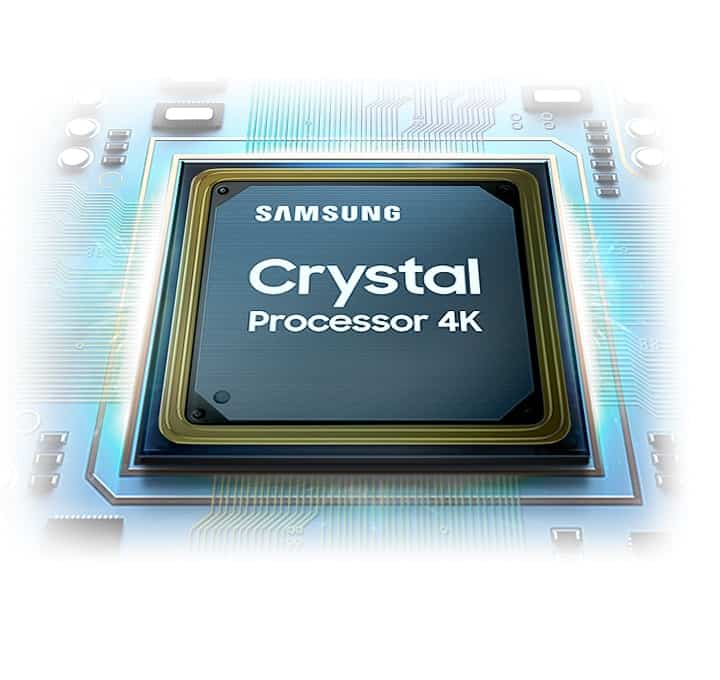
Samsung Crystal Processor 4K
The signature Crystal Processor 4K upscales all content to a 4K resolution. This wasn’t always possible: if you wanted to watch some of your favorite movies or TV shows in 4K, you couldn’t upscale it even if you had a 4K TV. You can do this with the Crystal Processos as long as your device is connected through an HDMI port.
Crystal UHD also features thin bezels for a fully immersive experience and the PurColor® technology that may not rival QLED. Still, it greatly improves the viewing experience when it comes to color accuracy.
Advantages of Crystal UHD over other technologies
Compared to traditional LED TVs, Crystal UHD has one obvious advantage: it comes in resolutions of 3840×2160 and higher. Since a change in resolution is one of the most obvious things that even entry-level users will notice, this is a significant improvement.
Crystal UHD TVs are superior to regular LED TVs in pretty much all other categories as well, including brightness, color vibrancy, viewing angles, etc.
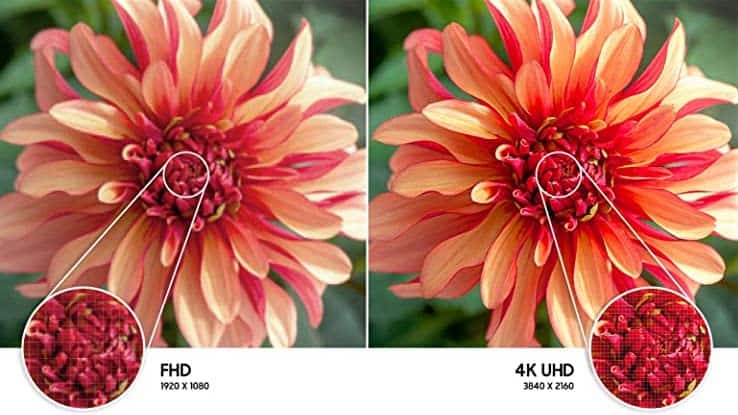
Samsung Crystal UHD produces bright, sharp, and vivid images
Samsung’s Crystal UHD can also address one big weakness LG’s OLED TVs have: daylight viewing. Due to a powerful LED backlight, Crystal UHD shines brightly even in well-lit living rooms during the day. It’s also less susceptible to burn-in, an issue that has been persistent with some OLED TVs, especially the older models.
Compared to QLED, Crystal UHD offers very little, except a lower price. They’re both manufactured by the same company, but QLED is obviously the more advanced, expensive product line that outperforms Crystal UHD in virtually every category.
That said, there are specific Crystal UHD models that can compete with some QLED models when it comes to refresh rates and other specs. For example, the Crystal UHD AU8000 offers 4K gaming at 120 Hz, while the QLED Q60A only supports 60 Hz and offers fewer HDMI 2.1 ports.
The disadvantages of Crystal UHD over other technologies
Since Crystal UHD doesn’t have a quantum dot filter, you’ll often notice that QLED TVs have a higher contrast ratio, higher brightness levels, and much more pronounced colors. The quantum dot filter makes a big difference, and it’s a big reason for the noticeable price increase compared to Crystal UHD.
Crystal UHD is also outperformed by OLED in almost every category, especially in contrast ratio and black levels.
In the current market landscape, Crystal UHD holds a position of affordable 4K TV sets but offers little more than that. This would place it right between a regular LED TV and more premium-priced QLED and OLED lines.
The best Crystal UHD TVs on the market
Here are some of the best Crystal UHD sets in Samsung’s offer right now.
AU 8000
The mentioned Crystal UHD AU8000 comes in six sizes, between 43’’ and 75’’. It features the excellent Crystal Processor 4K, four HDMI 2.1 ports, and supports 4K gaming on 120 Hz.
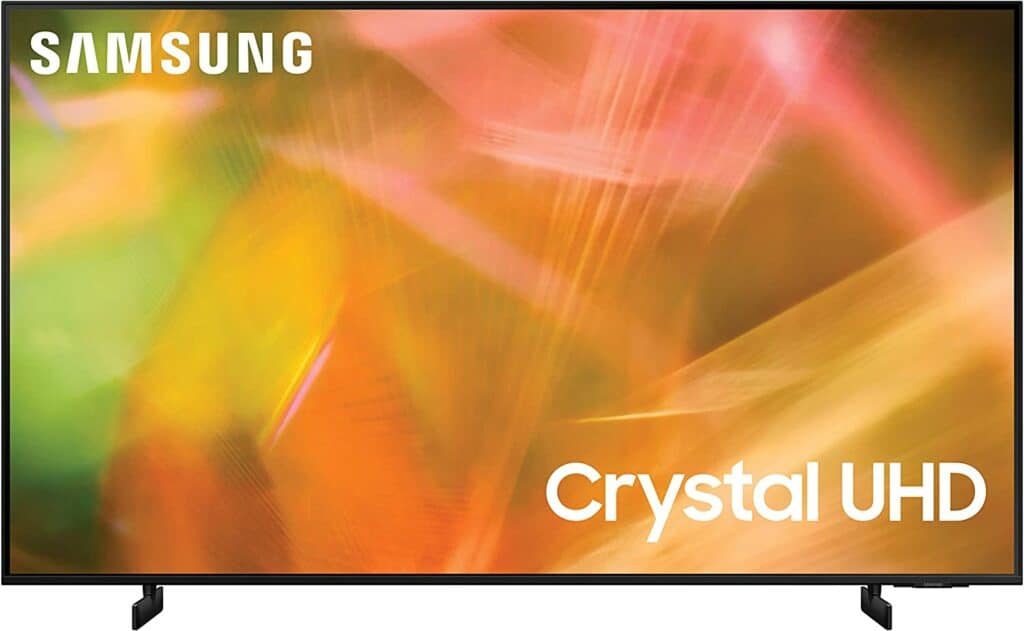
TU 9010
If you want to go for a high-end option, the TU 9010 86-inch offers many of those same features on a larger screen. It also comes with built-in voice assistants and a great motion rate to minimize motion blur.
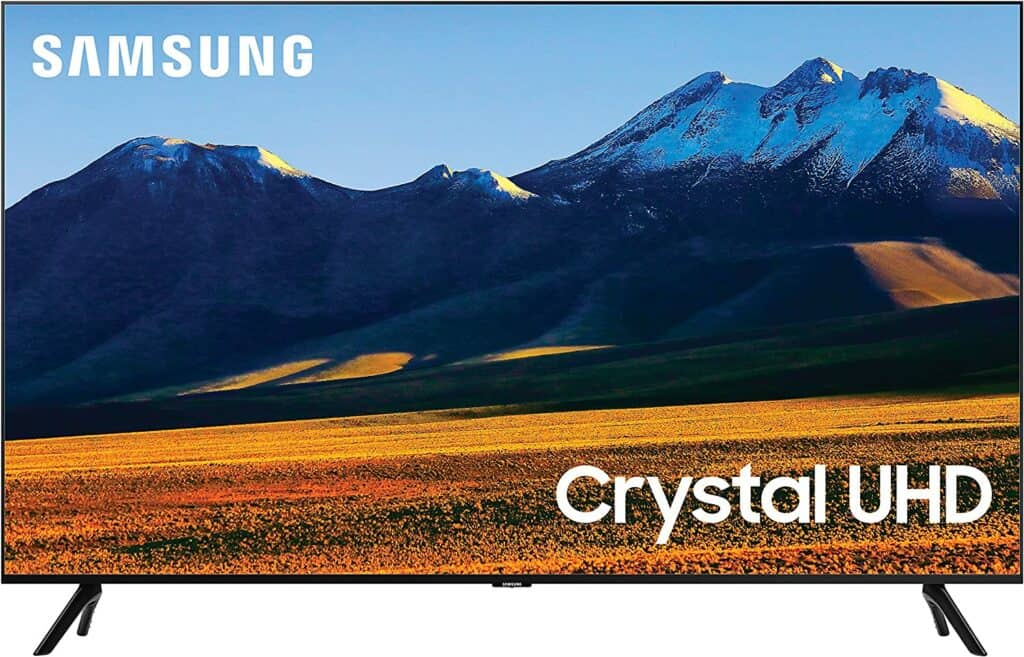
TU 8300 Curved
There is a case to be made for curved TVs and monitors when it comes to immersion, which is a big deal in gaming. This TU 8300 is a great choice for a gaming 4K TV, although its refresh rate is 60 Hz.
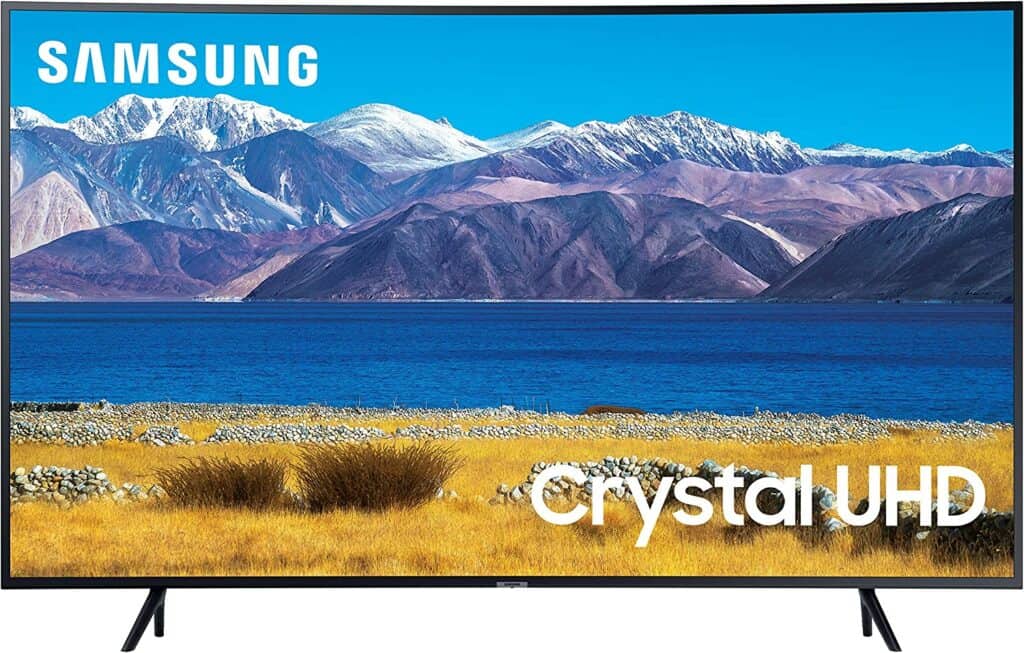
Samsung TU 8300 Curved TV
What is QLED technology?
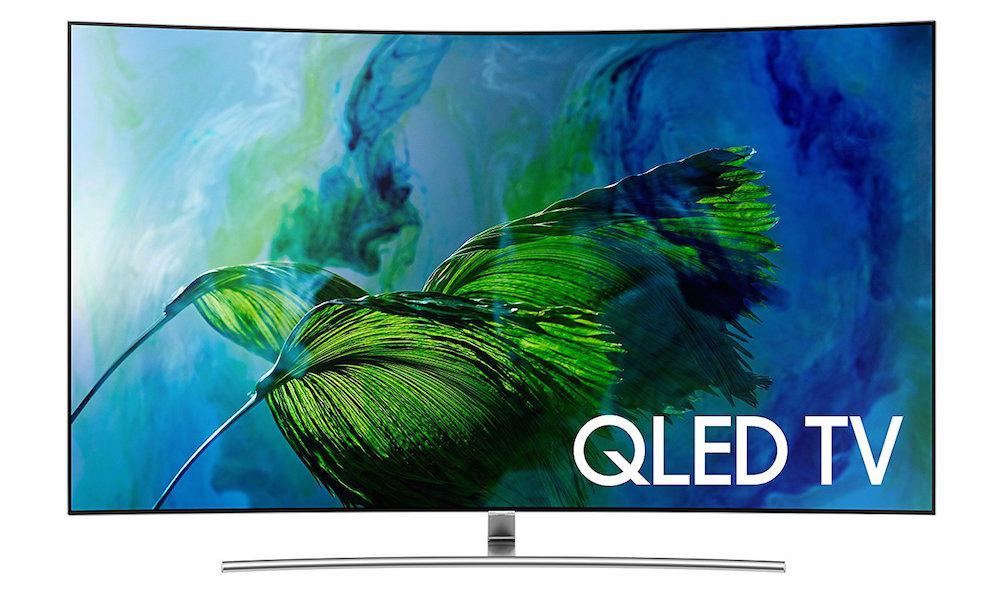
QLED stands for Quantum LED or Quantum Light-Emitting Diode – its name stems from the quantum dot layer positioned in front of the LED backlight, which significantly improves image quality.
Currently, QLED is Samsung’s main focus in the TV market, especially in the high end of the pricing spectrum. Certain 8K QLED TVs are among the most expensive, best sets you can find on the market.
Although Samsung is the most significant manufacturer of QLED panels, brands like TCL, Hisense, and Vizio all sell QLED TVs.
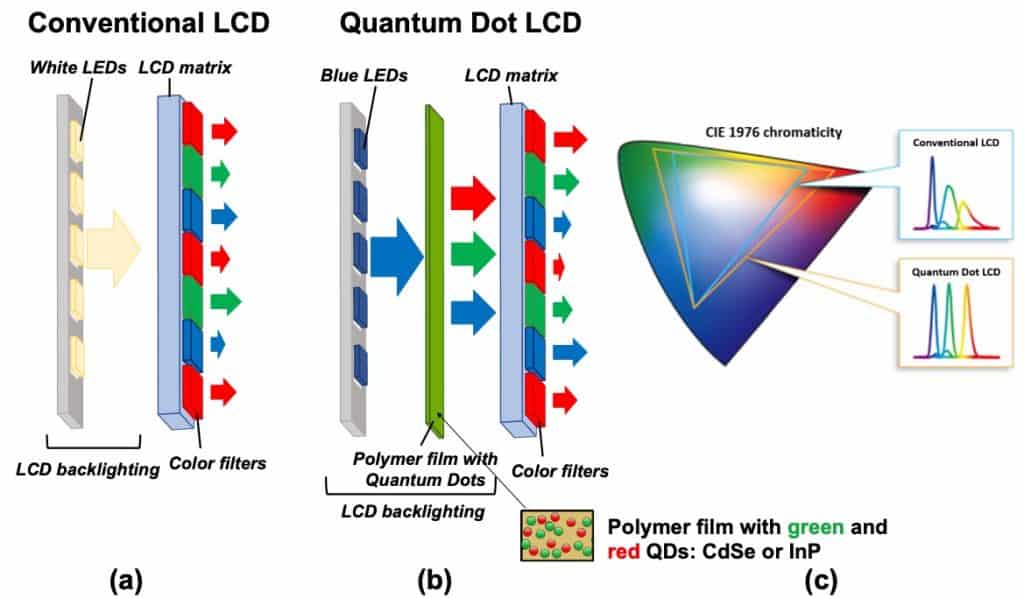
A QLED panel compared to a conventional LCD
How does QLED work?
Similar to Crystal UHD, QLED isn’t an extensive overhaul of the existing LED technology. It doesn’t do away with the LED backlight, but it does provide an important update that’s just impressive enough to help it rival OLED.
The update in question is the quantum dots we mentioned – semiconducting nanoparticles that can absorb the light from the LED backlight and emit light of a different wavelength. The exact wavelength can be altered precisely, which is useful for display devices that need color precision and contrast.
In simpler terms, the quantum dot layer is an essential addition to existing LED technology that dramatically improves the viewing experience. Combined with other innovations, it makes QLED competitive in the high-end TV market.
Advantages of QLED over other technologies
QLED’s main competitor is the OLED panel technology from LG: the two companies offer competing products at similar price points, and they both target the high-end market.
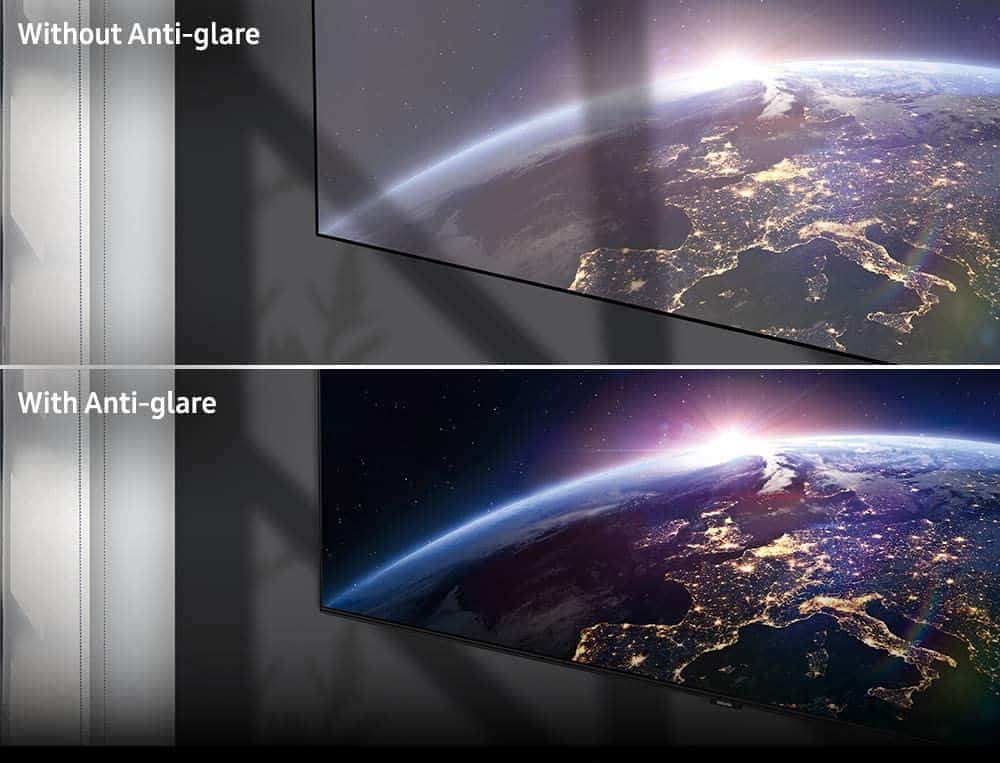
Samsung Ultra Viewing Angle with Anti-Glare
Compared to OLED, QLED offers higher brightness levels and much better performance in daylight conditions. Although OLED has addressed this with newer models, the fact that QLED panels still have an LED backlight is hard to overstate in this case. If you’re looking for a top-tier LED TV for a living room that receives a lot of sunlight, QLED might be your best choice.
Since QLED is a premium product line, it outperforms Crystal UHD in almost every relevant category. Although it depends on the specific model and size, QLED generally offers higher contrast and brightness, wider viewing angles, and deeper blacks. OLED is still the master of the black range but, compared to Crystal UHD, QLED generally performs better.
Disadvantages of QLED over other technologies
On the other hand, QLED still can’t measure up to OLED. Even with the most expensive QLED sets, you’ll occasionally experience some of the ailments that come with traditional LED TVs: light bleeds, an unconvincing black range, and relatively lousy viewing angles.
The lack of a backlight in OLED panels means they managed to address many of these insufficiencies to a great extent. As outlined in our OLED vs QLED comparison, the individually lit pixels in OLED panels produce the best black range and viewing angles on the market.
Another thing worth mentioning is power efficiency. The LED backlight in QLED panels consumes much more energy than OLED TVs, which are at the top of the class when it comes to power saving.
Compared to all other panels on the market, QLED is still among the best performing technologies you can get right now. Its closest competitor is LG’s NanoCell, although QLED seems to be a more advanced, more widely adopted technology at the moment.
The best QLED TVs on the market
The QLED market is vibrant and served by various capable brands. Here are some of the best QLED TVs on offer.
Samsung Q80A
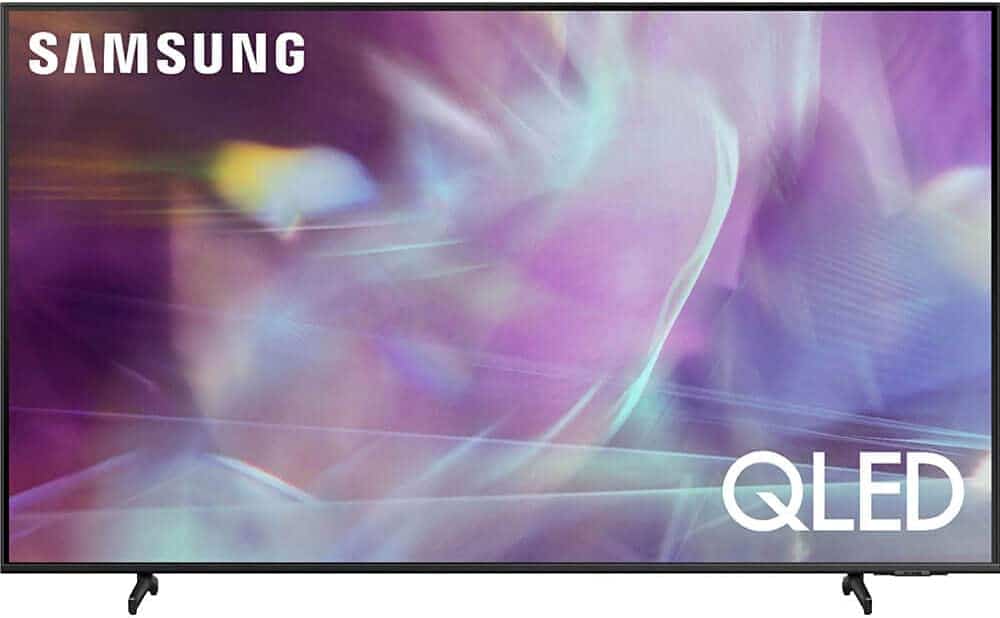
The latest QLED TV from Samsung, the Q80A comes in more than four sizes. It also offers OTS (Object-Tracking Sound), a signature technology that tailors the sound to the action on the screen. Along with a 120 Hz refresh rate and four HDMI 2.1 ports, it’s one of the best QLED TVs you can get at the moment.
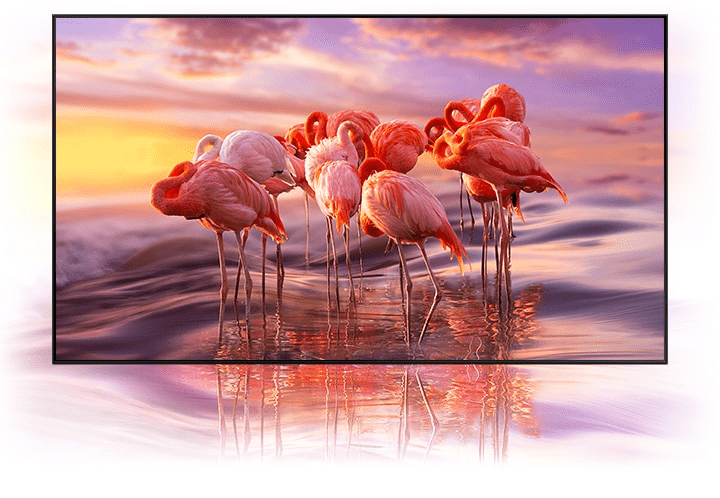
Samsung Q60A
If you’re looking for something a little more affordable, the Q60A is an excellent option. It comes in 10 sizes, from 32’’ to 85’’, and features the Lite version of the mentioned OTS technology. However, the Q60A isn’t ideal for next-gen gaming with a 60 Hz refresh rate.
TCL Class 6-Series
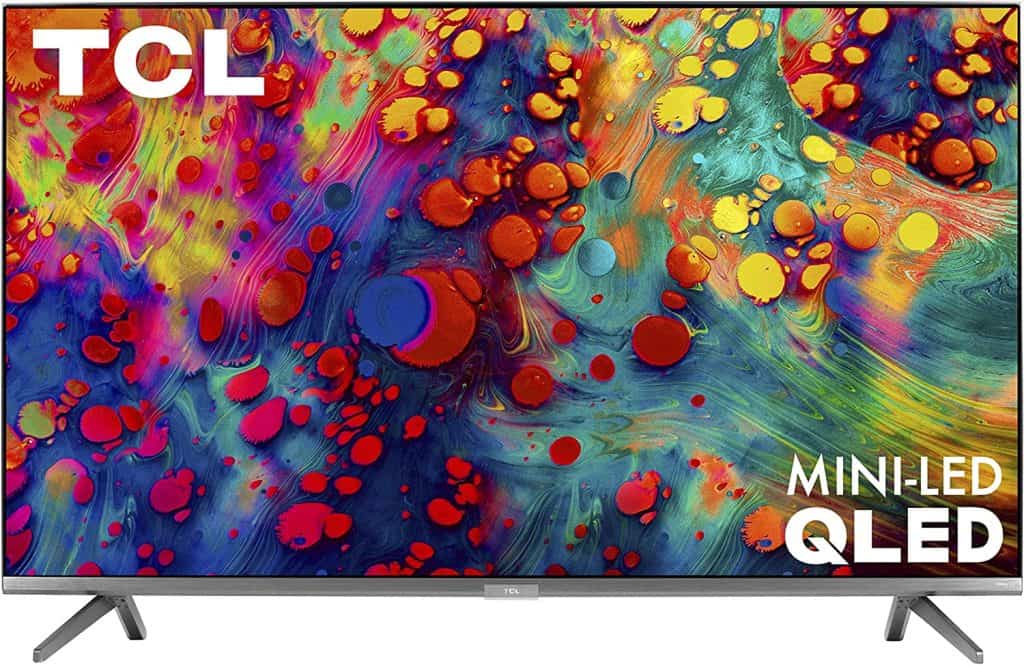
The QLED market is by no means exclusive to Samsung – among others, TCL makes some outstanding QLED panels. Some of those can be found in the 6-Series: a 120 Hz refresh rate, an elaborate game mode, and four HDMI 2.1 ports make this model as impressive as it is affordable.
TCL 6 Series 2020
QLED vs Crystal UHD – key differences and similarities
Comparing Samsung Crystal UHD vs QLED, you can see that they have one big thing in common: they both use a backlight that provides the same benefits and limitations as other technologies (OLED in particular).
High brightness levels, excellent contrast, and unmatched performance in well-lit environments are something that both of these product lines have been offering for a long time.
On the other hand, they both struggle with black levels, color bleeding, and viewing angles – all due to the LED backlight they both have.
It’s important to mention that QLED has addressed many of these issues and surpassed Crystal UHD significantly in the past few years. The color vibrancy and brightness that QLED provides are top-of-the-market, outperforming even the more expensive OLED models.
All of this comes at a price: you’ll find that most QLED TVs are more expensive than their Crystal UHD counterparts when measured per inch.
Here’s a detailed comparison of the two product lines across several categories.
| Comparison | QLED | Crystal UHD |
|---|---|---|
| Brand(s) | Samsung, TCL, Hisense, Vizio | Samsung |
| Market segment | Premium | Mostly mid-range with some high-end models |
| Technology used | A quantum dot filter that enhances color performance | Standard LED technology in 4K resolution |
| Viewing angle | Generally narrow but improved with recent models | Narrower than QLED, some discoloration for outside-seated viewers |
| Contrast and brightness | Higher contrast and brightness, contrast ratio over 4,000:1 | High contrast and brightness, contrast ratio can go over 4,000:1 in more expensive models |
| Black levels | Deep, more nuanced black range | Unconvincing black range |
| Perfect viewing conditions | Any, but better in dark, dimmed rooms | Daylight |
| Product variety | Offers a wider range of products, also available from other brands | Only offered by Samsung, lacks high-end options |
Conclusion
Looking at Samsung’s Crystal UHD vs QLED, the comparison is quite clear: QLED is marketed and produced as a premium option, while Crystal UHD is a line of standard 4K TVs.
However, “standard 4K” is almost an oxymoron. There’s nothing standard about 4K, and there are some amazing models to be found in Samsung’s Crystal UHD offering that will blow your regular LED TV out of the water.
The key question here is whether it’s worth paying the few hundred bucks extra to get a QLED TV over a Crystal UHD. This question is for each user to answer on their own, and it may ultimately come down to particular models and retailers’ offers.
QLED will provide you with a better viewing experience across the board: higher brightness and contrast, deeper blacks, better color vibrancy, and wider viewing angles. You should probably pay the additional price if you’re a cinephile.
Crystal UHD offers some impressive models that can rival QLED, especially in the gaming category. If you’re a budget user, you can probably find some great Crystal UHD models at a bargain rather than spending extra money on a QLED TV.
About Jon
Hey, I’m Jon. I’m an engineer by trade, so it makes sense that I’m obsessed with anything technology related! On the weekends, you can find me playing around with my computers or fixing something around the house. Feel free to leave a comment if you want to get in touch.
Crystal Uhd Vs Qled Displays On Smart Tvs
Samsung is responsible for the introduction of both Crystal UHD and QLED. This is why they are mainly found on Samsung TVs and monitors. This does not stop other manufacturers from establishing similar products that claim to have similar technologies and features. In this post, we will make it easier for you to close your search by putting up the Crystal UHD against QLED. We shall look at what similarities both technologies share, and how they differ. And even more importantly find out which one is better. Related Post:
How To Buy A Gaming TV (2022 Buyer’s Guide)What’s an 8K Ultra HD Display?
What Is Crystal UHD Display Technology?#
As the name suggests, Crystal UHD uses a special nanocrystal layer to enhance contrast and color reproduction. The end result is a more realistic image. Crystal UHD is a technology developed by Samsung intended to offer better picture quality than traditional 4K LED TV displays. This is a relatively new technology with a lot of potential to be the next standard for TV displays. The Crystal UHD concept came from Samsung as a promise of a crystal clear picture to consumers. The stand-out feature of Crystal UHD displays is their accurate color production. Which is a result of the crystal layer that filters out colors much better than QLED. Additionally, since the crystal layer can block out more light, it results in deeper blacks and brighter whites. This means much better contrast ratios. Related Post:
LED, LCD, OLED, QLED: Understanding smart TV display TechHDR Standards Explained — HDR10, Dolby Vision, HLG
Colour Accuracy and Picture Brightness#
The color production of Crystal UHD is very consistent and very accurate hence there is no color bleeding or misrepresentation. This a display that is best suited for professional applications where color correctness is of paramount need. All thanks to their wide color gamut. A potential downside of Crystal UHD displays is that they suffer reduced brightness output when compared to some other high-end displays. This is especially so if you are using them in locations with high ambient lighting. Though it can be partially mitigated by getting a Crystal UHD display that is HDR enabled. That is if you need brighter picture outputs. Crystal UHD displays use LED backlighting that produces a brighter picture than traditional LCD displays. But not as much as QLED displays. We have to emphasize that even though the brightness levels are decent for a majority of applications, it is not the best in the market. Also, the backlighting of a Crystal UHD display can be adjusted to suit your comfort levels. This is also what contributes to the wide viewing angle of these types of displays. They are excellent displays for persons who are looking for a clear picture that can be viewed from every angle in their living room. Related Post:
HD, FHD, Quad-HD, UHD: Understanding High Definition video resolutionsUnderstanding Smart TV Picture Resolution
What Is QLED Display Technology?#
QLED stands for Quantum Dot Display where quantum dots are embedded in a matrix layout to make a display panel. Quantum dots are minute semiconductor crystals that emit light when you excite them using an electric current. The quantum dots are what illuminate and display pictures using the Red, Green, and Blue (RGB) format. QLED displays are an advancement of LED displays that can be found in a wide variety of products ranging from mobile phones, to TVs, and PC monitors. A benefit of QLED displays is that they are more energy efficient than Crystal UHD hence your power bills will be lower. Additionally, QLED displays can be made much thinner than their counterparts; the Crystal UHD. A downside to QLED displays is that they are usually more expensive than their counterparts for similar sizes and specs. Related Post:
How different is 8K from 4K?Best Web Browser For Your Android TV
Colour Accuracy and Picture Brightness#
The wavelength of the light that is emitted by the quantum dots is what determines the color output of a QLED display. QLED panels can display a wide range of colors because each quantum dot can emit light at a specific wavelength. This means that QLED displays are capable of producing a wide range of colors, some of which cannot be seen by the human eye. Just like with picture color accuracy, the brightness of QLED displays also depends on the wavelength of light that is emitted by the quantum dots.
What Should You Choose: Crystal UHD or QLED#
As you may already guess, there is no simple answer on which is better when choosing between Crystal UHD and QLED TVs. It all depends on your specific preferences and needs because both have their advantages and disadvantages. With Crystal UHD TVs you can expect better color accuracy and a wider color gamut than QLED. They also have a decent peak brightness which is good for HDR content. On the downside, Crystal UHD TVs have a lower level of local dimming compared to QLED TVs. That means that in dark rooms your black will not be as dark as compared to QLED. On the other hand, QLED TVs boast better local dimming meaning they are brighter than Crystal UHD TVs. That makes them best for use in rooms with a lot of ambient lighting. QLED TVs also have lower input lag than Crystal UHD which means that they are better for gaming. But keep in mind that their color performance is not as good as that of Crystal UHD displays. The bottom line here is that if you are looking for the best possible picture quality buy yourself a Crystal UHD TV. But if you are looking for the best performance in gaming you are better off with a QLED TV. Do you already own a TV with either of these technologies? Kindly leave us a comment down below with your experiences so far. Related Post:
What 4K HDR and how different is it from 4K UHDWhat are Mini-LED TVs and Why Do They Matter Now 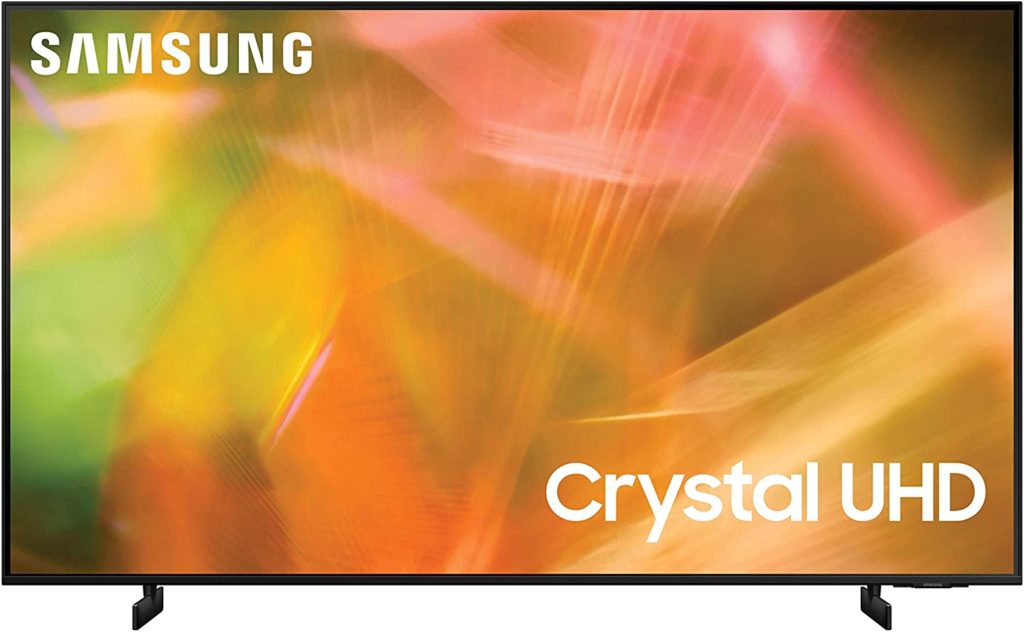

Which Is Better Crystal UHD Vs QLED [2023] | Do It Something
Did you know about Crystal UHD Vs QLED TV, if yes then this article is for you. We will be discussing Crystal UHD Vs QLED. Read on for more.
While both types of TVs have their own advantages, the QLED is better at delivering brighter images and improved reflection.
It uses less power and is more efficient than Crystal UHD. A QLED also has a quicker on-and-off time than a Crystal UHD. Unlike its rival, but the QLED does not produce its own light and is dependent on a backlight unit for illumination.
This means that its quality affected by the angle of viewing and will change colour as you move your head.
The biggest differences between QLED and Crystal UHD are in colour performance. QLED TVs offer higher contrast and brightness while Crystal UHD TVs are more accurate in colour range. While QLED televisions offer better contrast and black levels,
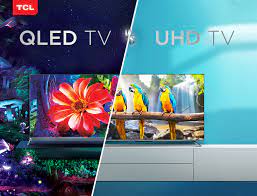
they also have lower refresh rates and lower sound capacity. Also, Crystal UHD TVs are better for darker rooms and better for watching games.
If you are on a tight budget, Crystal UHD is a better option. But if you are looking for a higher-end model and have more money to spend, QLED is the best option.
There are many benefits to both, and you should choose your check according to your specific needs and budget. QLED televisions are becoming popular, and the choice of colour technology is important. But, you should know that both types of televisions use a backlight and have different processing systems.
A crystal UHD TV has a crystal processor, while a QLED uses a quantum processor. This means that they have better colour reproduction and AI features.
Crystal UHD Vs QLED – Which Is Better
When choosing a television, you have to decide which technology is best for you. There are pros and cons to both technologies.
QLED provides better brightness and contrast, while Crystal UHD has a wider colour gamut and lower refresh rates. QLED is also better for gaming, and is better in dark rooms.
QLED
Both QLED and Crystal UHD TVs boast 4K resolution, but what’s the difference between the two? Both feature
LED backlights and several layers of pixels to create a high-resolution image. While neither offers anything new to the LED space, they are significant improvements over standard LEDs.
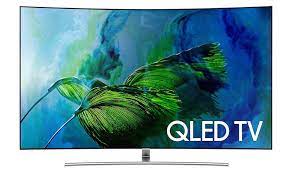
Although both TVs use LED backlights, QLED’s quantum dots have the advantage of reduced power consumption. That’s a huge benefit in today’s energy-efficient TVs.
Crystal UHD TVs, , use LCD and LED panels, which use more power.
When comparing the two types of display, consider the price difference. Samsung’s Crystal UHD costs much less than its rival QLED, but it still offers more features. QLED TVs can cost anywhere from $500 to more than $10,000.
Crystal UHD
Crystal UHD and QLED are both high-resolution televisions. They marketed as similar but differ in some key aspects, such as picture quality.
Crystal UHD is the more affordable option, and offers better contrast and colour reproduction than QLED. Both televisions are energy efficient, using less power and producing less heat than standard LCDs.
They are also capable of displaying HDR content, including high-dynamic-range (HDR10) and hybrid log-gamma (HDR10).
While Crystal UHD is still in its infancy, it has the potential to revolutionise the television market. Its colour output is accurate and consistent, with virtual no colour bleed, which makes it perfect for photographers, videographers, and other professionals.
One of its disadvantages is that it is not as bright as QLED and other higher-end televisions, but this can remedied by using a HDR-compatible display or increasing the backlight setting.
QLED: The power consumption of a QLED television is lower, thanks to its quantum dots. Compared to an LCD panel, a QLED television uses fewer lumens per square inch and can turned on and off more .
Why Crystal
There are plenty of good reasons to learn the newest programming language, Crystal. For starters, it’s fast and readable – much like Rust! And the language also has fibres,
which is not free in the C++ world, but makes writing game loops, UI classes, events, and asynchronous IO a breeze.
Crystals are powerful, and the vibrations they emit are very powerful. If you want to use them, take the time to let go of the stigma associated with them.
Pay attention to the pulsating sensation – it could feel like your heart is beating. And don’t forget to ask yourself: “Does this crystal make me feel calmer?” If not, consult a crystal healer, such as Judith Finney.
There are many benefits of crystal healing. It can help you clear negative energy and attract good energy. While some people dismiss this as pseudoscience, some research shows that crystals can help people. According to Audrey Kitching, a former model and alternative healer, the ancient Egyptians used lapis in jewellery and malachite in makeup, believing that it had healing powers.
For centuries, people have fascinated by crystals. They used for divination, healing, and spiritual advancement, and even as decorative objects.
In the Middle Ages, they thought to have magical powers. They also believed crystals were able to emit light.
Are Crystal UHD TVs Bad
LED TVs and OLED screens have low dynamic range and limited colour gamut. In contrast, crystal UHD TVs have high dynamic range and a wide variety of colours.
But, they are more expensive than other types of television. While you might not want to pay for crystal UHD TVs, they are still worth it for the quality and detail they offer.
Crystal UHD has four times the resolution of Full HD, which makes it four times more vivid. Samsung has taken this technology and made it available in a range of sizes and positions.
With an array of features, you can customise your television to fit your space, needs, and preferences. It even includes one remote, Universal Guide, and Clean Cable Solution.
Another reason to consider a Samsung Crystal UHD TV is its HDR features. It allows full colour contrast, which is much better than HDTV.
It also uses PurColor technology to enable millions of shades of colour. Other TVs only work with primary colours, but Samsung implements secondary colours as well. This means that you’ll get much richer colours, with fewer thick screen borders.
LED TVs use an array of LED lights to display images. But, Crystal UHD TVs use ‘Crystal’ technology to display images.
Millions of tiny micromirrors used in this type of panel. As a result, they can produce higher resolution images. But LED TVs also suffer from light bleed and other problems.
Frequently Asked Questions
A: Crystal UHD is a type of LED display technology developed by Samsung, while QLED (Quantum Dot LED) is a type of display technology that uses quantum dots to enhance color accuracy and brightness.
A: QLED generally has better picture quality due to its use of quantum dots, which can produce brighter and more accurate colors.
A: QLED is generally more expensive than Crystal UHD, as it is a newer and more advanced technology.
Conclusion
This was our guide – Crystal UHD Vs QLED.
It uses less power and is more efficient than Crystal UHD. A QLED also has a quicker on-and-off time than a Crystal UHD.
Unlike its rival, but, the QLED does not produce its own light and is dependent on a backlight unit for illumination.
This means that its quality affected by the angle of viewing and will change colour as you move your head.
The biggest differences between QLED and Crystal UHD are in colour performance. QLED TVs offer higher contrast and brightness while Crystal UHD TVs are more accurate in colour range. While QLED televisions offer better contrast and black levels,
We hope that this article has helped you to know Crystal UHD Vs QLED TV. If you have any questions then let us know in the comment section.
Что лучше Qled или Crystal Uhd �� 2021
В целом QLED имеет более высокое качество изображения и яркость. Он также лучше обрабатывает рефлексию.
С другой стороны, Samsung «Crystal UHD» намного дешевле.
Что такое QLED и что такое UHD?
QLED — это ЖК-телевизор с квантовыми точками.
UHD или «Ultra High Definition» относится к разрешению телевизора (3840 x 2160). Это не совсем то же самое, что 4k, но большинство из них продаются как таковые.
Основное отличие состоит в том, что «Crystal UHD» не имеет технологии QLED.
Что есть у обеих моделей телевизоров
Прежде всего, оба сделаны Samsung.
Оба телевизора LCD/LED.
Оба имеют схожие возможности подключения: HDMI, Wi-Fi, Bluetooth.
Операционная система: Тизен.
Разница между двумя
Как я уже говорил, «Crystal UHD» не имеет технологии QLED. Так:
- Технология QLED обеспечивает лучшую яркость и цветопередачу (см. Видео ниже). Это делает QLED лучше для использования в дневное время.
- Игры: QLED немного лучше, когда дело доходит до игр (более новая технология «Game Enhancer»).
- Аудио: QLED имеет немного лучший звук.
Примечание. Разрешение может быть одинаковым в зависимости от сравниваемых моделей телевизоров.
Какой из них лучше?
Подытожу в таблице ниже. Зеленый цвет означает, что он лучше, а красный означает, что он хуже:
Итак, если вы ищете лучшее качество изображения, выбирайте QLED. Если у вас ограниченный бюджет (или, может быть, вы не видите разницы на видео ниже), выберите Samsung «Crystal UHD».
Рекомендация
видео
Совет: включите кнопку подписи, если она вам нужна. Выберите «автоматический перевод» в кнопке настроек, если вы не знакомы с английским языком.
Вопросы-Ответы
Стоит ли QLED дополнительных денег.
Телевизоры QLED стоит покупать, если вы регулярно транслируете фильмы, игры или шоу. Если вы ищете телевизор с дисплеем повышенной яркости, слой квантовых точек поможет добиться дополнительной яркости по сравнению с традиционным ЖК-изображением.
Хороши ли телевизоры Crystal UHD.
Они более просты, но все же отлично подходят для основных задач, таких как потоковая передача. Все они имеют разрешение 4K и поддерживают HDR (высокий динамический диапазон), что обещает лучшую цветопередачу, но имейте в виду, что бюджетные телевизоры, как правило, не имеют достаточно хорошей яркости, чтобы максимально использовать ее.
Ищете новый телевизор?
Выбор телевизора может быть очень сложным, если вы ничего не знаете о технологиях.
Некоторые будут платить за функции, которые им не нужны, в то время как другие могут не учитывать то, что им действительно нужно.
Поэтому я создал это краткое руководство для новичков, которое поможет вам сосредоточиться на том, что действительно важно для вас: