Can HDMI Be Converted to DisplayPort?

Have a DisplayPort monitor but are not sure you can use it with your gaming console?
Imagine how cool it would be to display Xbox on your DP-enabled monitor.
Below, you’ll discover whether your HDMI can be converted to DisplayPort.
It’s the Big Q that holds the solution to your above-mentioned dilemma.
Most importantly, you’ll learn a simple way to make the conversion.
Can HDMI Be Converted To DisplayPort?
Yes. With the correct conversion adapter, you can convert HDMI to DisplayPort.

- COMPACT DESIGN — The compact-designed portable Benfei HDMI to DisplayPort adapter connects a.
- SUPERIOR STABILITY — Built-in advanced IC chip converts HDMI TMDS signal to DisplayPort digital.
- ULTRA 4K@60Hz RESOLUTION: The adapter is fully compatible with DisplayPort 1.2a, HDCP 1.3/1.4/2.2.
Last update on 2023-10-12 / Affiliate links / Images from Amazon Product Advertising API.
Although the two signal types are different in terms of their technical makeup, they are compatible.
The newer DisplayPort is backward compatible with HDMI, so it’s easy to connect it to any HDMI device.
That means you can transfer data between an HDMI device and a DisplayPort device using a cable.
But because you’re dealing with two distinct interfaces, you have to rely on a converter to translate the HDMI signal coming from the source to a signal that the DisplayPort device can recognize.
Can HDMI 2.1 Be Converted To Displayport?
At present, there are no adapters that specifically translate HDMI 2.1 signals to DisplayPort.
If you have an HDMI 2.1 port and wish to connect it to a DP monitor, your best option is an HDMI 2.0 adapter.

- 【Unidirectional HDMI to DP Monitor】 FOINNEX HDMI output to DisplayPort input active adapter.
- 【For Game Mode】 HDMI to Display Port converter also suitable for gaming console to monitor, like.
- 【4K@60Hz】HDMI 2.0 to DP 1.2 support resolution up to 3840×2160 @60Hz. Please check your devices.
Last update on 2023-10-12 / Affiliate links / Images from Amazon Product Advertising API.
Such a conversion adapter will give you HDMI 2.0 video quality—that is, 4K at 60 Hz. No doubt this is way lower than the 4K @ 120 Hz you would get with an HDMI 2.1 conversion, but it’s the best you can hope for, at least for now.
This situation will likely change soon as more devices feature HDMI 2.1 ports. HDMI 2.1 to DisplayPort adapters will become more readily available then.
Can we be sure such adapters will become available?
Unfortunately, until we hear from conversion adapter makers, we cannot be 100% certain of when they will manufacture HDMI 2.1 to DP adapters, if at all. However, going by past trends, we can confidently argue that they will probably produce such adapters.
When the HDMI 1.4 spec was released, cable makers gave us HDMI 1.4 to DisplayPort adapters. And when HDMI 2.0 came out, they did the same with HDMI 2.0 to DisplayPort adapters.
Therefore, chances are they will do the same with HDMI 2.1, seeing as we already have DisplayPort to HDMI 2.0 adapters on the market.
Moreover, the uptake of HDMI 2.1 devices is increasing. That and the subsequent demand for products that link the newest HDMI spec to DisplayPort mean adapter manufacturers have a ready market that’s waiting to gobble up the product. And that may be the signal they need to avail HDMI-DP adapters.
How To Convert HDMI To Displayport?
Start by obtaining a quality HDMI to DisplayPort adapter.
Before buying, confirm that the adapter is HDMI to DP, not DP to HDMI.
Why does this matter?
Because the latter only translates signals from DP and does not have the mechanism to translate HDMI signals to DP.
Some adapters are bidirectional, and they carry signals in both directions across two different interfaces. It’s a scenario you see a lot with HDMI-DVI adapters, for instance, because they have a similar signal transmitting technology (TMDS).
The HDMI-to-DisplayPort connection, however, does not work the same way for two main reasons:
Firstly, HDMI and DisplayPort use different signal transmission protocols. HDMI uses Transmission-minimized differential signaling (TMDS), while DisplayPort uses Low-voltage differential signaling (LVDS).
Secondly, each has a different power capacity. HDMI connectors provide a minimum of 5V, while the DisplayPort power pin provides 3V.
So, any adapter transporting a signal from HDMI has to support 5V from the source end. Likewise, any adapter that transports a DisplayPort signal must support 3V from the source end. As such, the adapter can only be unidirectional. It cannot carry signals bidirectionally.
Can’t figure out which adapter to use?
The Cable Matters HDMI to DisplayPort adapter below is a good option, specially built to withstand frequent use.
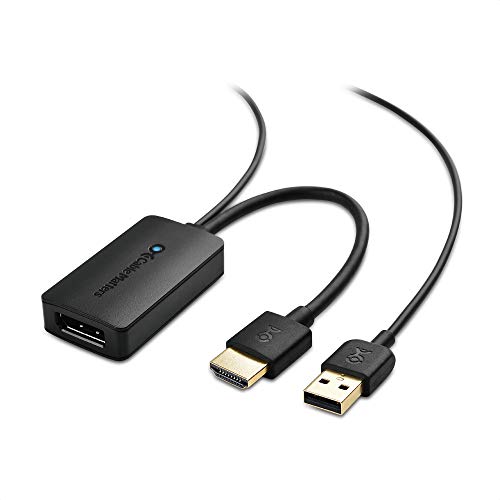
- HDMI to DisplayPort cable adapter connects a computer or laptop with HDMI to a monitor with.
- Active HDMI to Display Port converter transmits high-definition audio and video from your computer.
- 4K Video Resolutionsupport up to 3840×2160 @ 30Hz including 1920×1080 @ 60Hz and 2560×1440 @ 60Hz.
Last update on 2023-10-12 / Affiliate links / Images from Amazon Product Advertising API.
Now that you’ve understood how to pick your adapter let’s see the actual conversion procedure.
Your HDMI-DisplayPort adapter will likely be active, meaning it contains extra chips to facilitate signal conversion. That would mean it also comes with a USB power cord, which you’ll need to plug into a separate power source.
Should you end up choosing a passive adapter, you won’t require an external power source. That’s because the adapter will use the power coming down from the source device connectors.
Here’s how to connect your devices for the HDMI-to-DisplayPort conversion, and we’ve outlined the simplified step-by-step guide for you below:
- If using an active adapter, plug the adapter charger into a socket. Active adapters mostly use USB power cords, so a USB charger works fine.
- Plug the HDMI end of the adapter into the HDMI port on your source device.
- Connect one end of a DisplayPort cable to the DisplayPort of the adapter.
- Plug the other end of the DisplayPort cable into the DP port on your monitor or projector.
- Turn on your devices.
Conclusion
You can convert HDMI to DisplayPort, but you will need an HDMI to DisplayPort converter/adapter to translate HDMI signals to DisplayPort. Using a converter that makes it possible for you to connect HDMI and DisplayPort devices.
A DisplayPort to HDMI adapter won’t be helpful since it works by translating DisplayPort signals to HDMI.
While there may be a few passive HDMI to DisplayPort converters, active adapters are more common and better performers for this kind of signal conversion.
Active HDMI-to-DisplayPort adapters intercept the HDMI signal flowing from the source device and change it into a DisplayPort signal. Then, they pass the transformed signal into the DisplayPort monitor through a DP cable.
Presently, only HDMI 1.4 to DisplayPort adapters and HDMI 2.0 to DisplayPort adapters are available.
If you’re working with an HDMI 2.1 to DP setup, you’ll have to pick an HDMI 2.0-to-DP adapter, which gives the closest quality to HDMI 2.1.
Connecting the adapter to your HDMI and DisplayPort devices is easy. Plug the HDMI end directly into the HDMI port of your video source, and then insert the DisplayPort end into the DP port of your display device.
Connect any power cords present to a USB charger/adapter, turn on the devices, and enjoy your content.

Meet Vance. He’s a proud dad, a seasoned software engineer, and an undeniable tech enthusiast. His expertise in computers was instrumental in crafting Pointer Clicker. Vance is passionate about simplifying tech for those who aren’t well-versed in it. Outside of work, he’s often found enjoying time with his son or diving deep into a video game.
HDMI — Display Port вопрос знатокам!
Будет ли работать данный кабель если источником вывода является HDMI?
Купил кабель, подключаю Hdmi к компуктеру, а Display Port к монитору и ничего не происходит. Погрешил на неисправный кабель, а н нет подключил к другому монитору в обратном направлении Display Port в комп, а Hdmi к монитору и все фурычит! В связи с чем возник вопрос, вывод через Hdmi как источник сигнала на Display Port вообще рабочий как вариант или все-таки что то с кабелем?
может он односторонний
Плюсую этого господина. Такие кабели, равно как и переходники бывают односторонними. Тебе вероятнее всего нужен активный адаптер. То есть не просто разводка пинов. Можешь поискать KVM-свитч с нужными портами, чтобы не покупать уж совсем бесполезный в перспективе переходник.
Так же замечу, что дешевый переходник скорее всего выступит бутылочным горлышком, например через такой мне не удалось выставить родное разрешение на 4к телике.
Вот вот. У меня работает видюха дисплейпорт — моник хдми, а вот моник дисплейпорт — ноут хдми не робит. Класека.
Can't convert HDMI to DisplayPort — root cause?
I have a DisplayPort based monitor, and a laptop with a DP out. I recently got a second laptop with HDMI out, and went looking for a HDMI -> DP converter. I was very surprised to find that such a thing effectively doesn’t seem to exist.
This answer and the Dell page it links to seem to imply that it’s just not possible to go HDMI -> DP, without a very expensive converter box (not just an adaptor). However, I can’t find anything that explains why this is the case. Is DP designed to be backwards compatible but can’t interpret HDMI? Is it a case of HDMI-quality signal not being high enough quality to be convertible? Some other reason?
Note that this question is not looking for an adaptor — I’m looking for the underlying cause of the lack of them.

5 Answers 5
HDMI is a clock-less video format, DP uses a clock to keep video in sync.
DP adds the clock to the video at the sending device; so a DP-receiving device needs to see a clock on the incoming video, HDMI doesn’t. This is why it’s very easy with a simple adapter to go from a DP output on a laptop to a HDMI input monitor because the monitor doesn’t care about the clock.
When going from HDMI to DP, the DP-receiving device is looking for a clock; HDMI sender does not have one, so this does not work. You need an ‘active’ adapter in this case and all that adapter does is add a clock to the video format and sends it out via DP. Notice I said "active" adapter—that’s the magic word you need to look for when getting an adapter to go from HDMI to DP.
It has absolutely nothing to do with the age of the video format (as another user put it "older standard"). HDMI 2.0 is newer than DP1.2 and the issue would still exist for the very reason I stated above.
Say goodbye to compatibility headaches with this simple HDMI to DisplayPort converter!
Discover how to convert HDMI to DisplayPort and connect your devices effortlessly. Learn about popular adapters and factors to consider for a seamless conversion!

At our site, you’ll only find unbiased reviews. However, we do earn profit from our affiliate links.
Are you having trouble connecting your HDMI-enabled device to a DisplayPort monitor or display? Many users find themselves in this situation, and conversion solutions are available. One of the common options is using an adapter for HDMI to DisplayPort conversion.
This blog post provides a comprehensive guide on converting HDMI to DisplayPort and useful tips when choosing the best converter adapter for your needs. Find out all you need to know about switching from one port type to another, so you can enjoy high-quality visuals!
Key Takeaways
- Converting HDMI to DisplayPort requires an adapter, which can be either passive or active.
- There are several key differences between HDMI and DisplayPort, including maximum bandwidth, support for ARC audio return channel, and their size/form factor.
- Possible advantages of using HDMI – >DisplayPort conversion include improved picture quality in UHD TVs, higher frame rates than possible over a single port connection and improved signal timing when connected via DP+.
- When choosing a converter adapter for converting HDMI to DisplayPort, you should consider compatibility with your devices, signal quality & performance, and ease of use
Understanding HDMI to DisplayPort Conversion
To understand how a HDMI to DisplayPort conversion works, users must first familiarize themselves with the different types of adapters available (active or passive) as well as key differences between HDMI and DisplayPort.
Types of conversion adapters (active and passive)
When converting HDMI to DisplayPort, there are two types of adapters that can be used: active adapters and passive adapters. Active adapters use additional chips inside the adapter to perform the conversion of signals from HDMI protocols into DisplayPort protocols, regardless of whether or not the source device supports a DP++.
On the other hand, passive adapters do not have any additional chips and rely on both ends having conducted relevant handshake protocols through which some data exchange will take place for successful conversion; thus, it is often important in this case for the source device to support DP++ capability too.
The key difference between active and passive conversions lies in their ability to convert without relying on extra features like USB-C auxiliary power supply as well as bandwidth reliance/limitations related ones at either end of this process – while an active converter has more versatility with resolutions when connected via standard cables compared to a passive one’s limited support when using generic cords only.
Key differences between HDMI and DisplayPort
HDMI and DisplayPort are both digital interfaces used for transferring high-definition audio and video. However, there are some key differences that make one better than the other, depending on your needs.
For example, the maximum bandwidth of each technology is different; while HDMI maxes out at 18Gbps, DisplayPort can transmit up to 32Gbps which supports higher resolutions and refresh rates.
Additionally, HDMI supports an Audio Return Channel (ARC) feature, which allows audio to be sent back from a display to an audio system; however, this feature does not exist in DisplayPort. Furthermore, consumers will more likely find HDMI ports on their devices, such as TVs and gaming consoles, while industry professionals prefer monitors with DisplayPort ports due to their ability to daisy-chain several displays with a single cable connection compared to multiple cables required when using HDMI.
Benefits and limitations of converting HDMI to DisplayPort
Connecting an HDMI-equipped device to a DisplayPort monitor or TV requires special adapters. Active adapter cables are used when users want to convert digital audio/video signals from HDMI to DisplayPort/mini-DP, while passive adapters are often found in the original packaging with most modern devices as they provide a simple link between two video and audio sources (HDMI and DP).
Key differences between the two include HDCP compatibility, signal integrity, range of features supported, such as variable refresh rates and power delivery. While both active and passive solutions offer advantages, there may be tradeoffs depending on circumstances.
Benefits of using HDMI to DisplayPort conversion include enhanced picture quality for 4K resolutions on Ultra-High Definition TVs; additionally, depending on the type of converter cable used – some outputs can support higher frame rates than possible via an all-in-one single port connection.
One downside is that it’s not as straightforward converting back from Display Port to HDMI since most monitors do not come with ports for this reason, so using alternative workarounds such as purchasing separate converters would need to be done if wanting access back to HDMI again after connecting another source via DP.
Top HDMI to DisplayPort Converter Adapters
are widely available, ranging from Cable Matters HDMI to DisplayPort Adapter, StarTech.com HDMI to DisplayPort Converter and FERRISA HDMI to DisplayPort Converter.
Cable Matters HDMI to DisplayPort Adapter
The Cable Matters HDMI to DisplayPort Adapter is one of the top-rated and most efficient adapters for converting HDMI to DisplayPort. Its innovative design allows it to handle Ultra HD 4K resolution, offering a hassle-free plug-and-play installation with no additional software or drivers required.
It provides smooth and seamless conversions from any device with an HDMI output into a display device that connects via DisplayPort. Furthermore, this adapter supports p resolutions which makes it perfect for use in Full HD monitors or projectors.
Additionally, you will need either passive adapters or cables if you want to convert HDMI signals to Dual Mode (known as DP++) DisplayPort, making sure that your signal quality remains untouched along the way.
StarTech.com HDMI to DisplayPort Converter
The StarTech.com HDMI to DisplayPort Converter is a popular adapter for converting standard HDMI signals into DisplayPort or Mini DisplayPort output. It features a durable construction and offers reliable signal transmission with seamless picture quality, making it easy to connect individual HDMI devices such as laptops, desktops, players, Blu-ray Disc drives to larger displays equipped with only a DisplayPort connection.
The adapter ensures an HD resolution of 1080p/ 1920×1200 and supports 4K 30Hz (UHD) resolutions for smooth video playback. Its versatile design makes it compatible with most Windows and Mac computers allowing simple plug and play installation without the need for any software or drivers.
Additionally, the ultra-slim design allows users to easily transport the converter in their pockets or bags, which is ideal when moving between workstations at home or office environments. Overall this provides an economical solution that efficiently and reliably converts HDMI sources into powerful DP outputs—ideal for professional audio/visual webinars presentations on the projector or external display.–.
FERRISA HDMI to DisplayPort Converter
is the perfect solution for those who want to seamlessly connect their HDMI devices to DisplayPort displays. This state-of-the-art converter enables high-definition audio and video transmission, allowing users to enjoy 4K resolution at 60Hz with no loss in quality.
With its easy setup and use, this cable adapter offers versatile connection options between HDMI and DisplayPort devices so that users can easily stream content from gaming consoles, computers, or BluRay players without any issues.
In addition, the FERRISA Converter allows reliable signal transmission even when used for a long duration, thus making it suitable for both leisure viewing as well as heavy gaming experiences.
Factors to Consider when Choosing a Converter Adapter
It is important to consider compatibility with your devices, signal quality and performance, as well as ease of use when selecting a HDMI to DisplayPort converter adapter.
Compatibility with devices and resolutions
is an extremely important factor to consider when choosing a HDMI to DisplayPort converter adapter. In order for the conversion process to work, both devices must be compatible with each other and support the same resolutions.
The compatibility of the device or resolution is determined by the type of cable, signal format, supported Hz refresh rate, and so on. If there are any discrepancies between these parameters, then it can affect how well the adapter works or if it can work at all.
For example, some adapters may not be able to handle higher resolutions, such as UHD (4K) or 1440p, even though they technically have enough bandwidth; however, an active adapter should suffice in this situation.
It’s also important to note that certain video cards require additional drivers and settings adjustment in order for them to properly communicate with their corresponding receiver/display port over HDMI-DP connection.
Signal quality and performance
Signal quality and performance is an important factor to consider when converting HDMI to DisplayPort. Signal quality impacts the display resolution, refresh rate, and overall visual experience of the user.
Poor signal quality can cause a number of issues, such as choppy visuals, image tearing, or stutter. High-quality active adapters that offer full bandwidth support are optimal for connecting your devices via HDMI to Displayport conversion as they ensure better picture reproduction and increase signal integrity between the devices.
When selecting an adapter for this type of conversion, always make sure it is compatible with both devices’ resolutions and supports a wide range of refresh rates varying from 24Hz up to 144Hz, depending on which DisplayPort cable you use.
Ease of use and setup
When looking to convert HDMI to DisplayPort, the quality of the adapter will play a major role in its ease of use. An active adapter is generally preferred for successful conversion, and this type of device is available on the market today.
Such an adapter should be high-quality and capable of delivering reliable performance when used with different devices. The setup process can typically be completed quickly and easily since most HDMI to DisplayPort adapters feature Plug-and-Play technology.
However, extra cables or other devices may need to be connected if there are compatibility issues between certain ports or resolutions that are too high for the converter being used. With some research beforehand, customers can find converters that fit their specific needs while offering easy setup and convenient plug and playback features for quick installation times.
Customer reviews and ratings
Customer reviews, and ratings are critical tools in helping customers select the best HDMI to DisplayPort converter adapter. They provide insights into the product’s performance, quality, and reliability based on real-world usage.
Product NameCustomer ReviewsRatings
Cable Matters HDMI to DisplayPort Adapter This converter is praised by users for its reliable operation and broad device compatibility. Customers appreciate the high-quality video signal it provides. 4.5/5
StarTech.com HDMI to DisplayPort Converter Customers have given positive feedback about the easy setup process and consistent performance of this converter. It’s also known for its high compatibility with diverse HDMI and DisplayPort resolutions. 4.2/5
FERRISA HDMI to DisplayPort Converter This converter has received commendations for its robust build quality, superb signal quality, and excellent customer support. It’s often noted for its ability to handle high-refresh-rate signals of up to 144Hz. 4.3/5
Argos HDMI to DisplayPort Adapter Though not as widely recognized as the others, this adapter from Argos has gained a following for its affordability and effective performance. Customers highlight its value for money and plug-and-play functionality. 4.0/5
In conclusion, customer reviews and ratings are invaluable when choosing an HDMI to DisplayPort converter adapter. They provide a clear picture of the product’s performance, helping potential buyers make informed decisions.
Conclusion
Converting an HDMI-enabled device to DisplayPort can allow users to identify and unlock new potentials in their devices. successfully picking the right adapter is crucial for making a successful conversion, however.
Knowing the basic differences between HDMI and DisplayPort offers users insight on how they should approach the conversion process, as well as familiarize themselves with possible factors that could potentially arise during it—i.e., not all adapters are compatible with certain resolutions or may even deliver weaker signals at times, making image quality differ from what we’d usually expect.
Before jumping ahead into purchasing any converter adapter blindly, remember to always read reviews of other customers first – generally speaking, both active and passive adapters available can offer good performance, but your best bet still lies in opting for those branded models coming from trusted companies such as FERRISA, StarTech or Cable Matters who have proven time after time that they deliver exactly what ends up being promised (or even more).
Additionally, subscribing to newsletters to stay power ahead of the latest developments/innovations regarding this topic might also be prudent if one wishes to make use of their purchased products judiciously (not let them sit idly due to technology evolutions).