CLIP from OpenAI: what is it and how you can try it out yourself

Neural networks (NN) and computer vision models in particular are known to perform well in specific tasks, but often fail to generalize to tasks they have not been trained on. A model that performs well on a food data may perform poorly on satellite images.
A new model from OpenAI named CLIP claims to close this gap by a large margin. The paper Open AI wrote presenting CLIP demonstrates how the model may be used on a various classification datasets in a zero-shot manner.
In this article, I will explain the key ideas of the model they proposed and show you the code to use it.
Intuition
In a typical classification scenario, one has a set of examples connected to a set of pre-defined categories. In such a set, the number of categories is fixed. If you train a model to distinguish between cats and dogs and then later decide to add a new class “bear”, then you will have to add example images with bears and train a new network!
However, if one were to train a network that connects an image to an arbitrary text, then you can utilize it with new classes simply by providing text description of that class. For this to work successfully, the network must learn good visual representations and good connections between visual cues and text.
How CLIP works
First, let us consider our problem scope. In order to connect images with text we need a dataset of image-text pairs. CLIP authors report that they assembled a dataset of 400 million (image, text) pairs from the Internet. The model will take an image as an input and predict text as an output.
There are different ways of representing text for prediction as shown on the figure below:
One can predict text with the correct word order, i.e. the classifier must output this is a photo of a cat . Or one can predict a label based on bag of words, i.e. the order of words is not important and if classifier predicts photo , cat , then it is correct. OpenAI suggests a further improvement upon the bag of words method and shows that CLIP is 4x more efficient in zero-shot ImageNet accuracy compared to previous methods.
CLIP achieves this by reframing the problem and using the contrastive pre-training. Instead of predicting label text, CLIP is training on predicting how likely this image is to correspond to that text.
Input images and texts are encoded, and their vector representations are used to build a similarity matrix (I*T is an inner product). Now, we know (during training) that the values on the diagonal represent correct classifications, so their similarity must be higher than those in the same row/column. This approach contrasts what we know go together (diagonal values) to what we know doesn’t go together (non-diagonal values). You can see that each row is a classification task: given an input image I, predict the text. Similarly, each column is a classification task: given an input text T, predict the image. During training, OpenAI used a very large size of mini-batches 32768 (N on the figure above).
During inference one takes a set of labels, creates texts based on labels and runs these texts through the text encoder. Text embeddings are later matched to image representation.
Classic classification training cares only about the predefined labels. If it is successful in findings dogs, then it doesn’t care if it is a photo or a sketch of a dog or a specific breed. Whereas CLIP training coupled with a large dataset makes the network learn various aspects of images and point attention to details.
One detail that is worth mentioning is that CLIP is sensitive to words used for image descriptions. Texts “a photo of a bird”, “a photo of a bird siting near bird feeder”, or “an image of a bird” all produce different probability paired with the same image:
CLIP in a real project scenario
To illustrate the potential of CLIP, I would like to show a real project use case, based on one of the projects I worked on for a customer, an image similarity search engine. In this project, a user submits an image to model and as a result get a list of images that are visually similar to the query image. In our case, images being searched corresponded to pages of PDF documents and may contain individually or a mix of text, tables, embedded photos, empty pages, schemas, diagrams, and technical drawings. For the customer, the search return images of interest were technical drawings. Additionally, we also knew that what user searches would only be based on technical drawings.
The key characteristics of these images are that they contain a lot of small details that may be highly relevant for interpretation and that they may contain irrelevant patterns. Here are a couple of examples of technical drawings:
As always, the devil is in the details, and in this case these are things like the fact that each image contains textual information block in the bottom-right corner. For example, if there are a lot of technical drawings from Pittsburgh Technical Institute, then they all will have a very similar text block. Thus, a neural network may very quickly begin to anchor to that block.
The ResNet-18 model used in production was trained using SimCLR approach. SimCLR is a self-supervised contrastive learning method that allows to learn good visual representations without image labels. The model was trained on 100k images, ca. 50 % of which were technical drawings and the rest were all the other types of images.
Following this, I benchmarked CLIP against SimCLR for visual similarity search. I found that image features from a released CLIP-based model taken as zero-shot perform on pair with SimCLR-based model trained specifically for that data. This is truly amazing given that technical drawings are not the typical candidates for publicly available datasets. I can’t explain why CLIP is able to perform so well on technical drawings, might it be that examples of such drawings were part of the training dataset.
Another result shown here is that CLIP was not training with image similarity in mind. Yet it learned useful representations that may be used in image similarity scenarios.
CLIP current limitations
CLIP authors are open about its limitations. CLIP struggles on more abstract or systematic tasks such as counting the number of objects and on a more complex tasks such as estimating relative distances between objects. On such datasets, CLIP is only slightly better than random guessing. CLIP also struggles with very fine-grained classification, such as telling the difference between car models, variants of aircraft, or flower species.
CLIP model itself is data hungry and expensive to train. If pre-trained model doesn’t work well for you, it may be not feasible to train your own version.
While zero-shot CLIP tries to reformulate classification task, the principles are still the same. And although CLIP generalizes well to many image distributions, it still generalizes poorly to data that is truly out-of-distribution. One example of this was CLIP’s performance on MNIST dataset where CLIP zero-shot accuracy was 88 %. Logistic regression on raw pixels outperforms CLIP.
Ability to adapt to new datasets and classes is related to text encoder. It is thus limited to choosing from only those concepts known to the encoder. CLIP model trained with English texts will be of little help if used with texts in other languages.
Finally, CLIP’s classifiers can be sensitive to wording in label descriptions and may require trial and error to perform well.
Conclusions
CLIP training pushes the boundaries of traditional classifier a bit further, and the released pre-trained model allows one to perform various computer vision tasks (classification, image feature utilization) with good performance and without a need of a training set. As one of the pain points when working on real projects in data science is data scarcity, where there may be a lack of ground truth data or the amount of data is limited. As I show with an example, pre-trained CLIP-based model allows to kick-start such projects — thus this development is a welcomed addition to the Data Science toolbox.
I hope you enjoyed a presentation the key aspects of how CLIP works, and a high-level demonstration of what it can be used on.
If you have found it interesting, I highly recommend reading the original paper where authors run a lot of different experiments and show how CLIP performs zero-shot classification on a broad range of datasets.
How to try out CLIP yourself?
I’ve prepared a Colab notebook that shows how to interact with CLIP. There you will find not only the basic procedure, but also some insights into how text descriptions affect the outcome. Be sure to check it out!
That notebook uses 16 portrait photos of 3 people. I wanted to see if CLIP can discriminate these people. It certainly can! However, as CLIP authors point out in their paper, at the current state of development CLIP may be not the best candidate to perform such tasks, but it is a good way to see how the model works. Its capabilities are anyway look very interesting.
Acknowledgments
Big thanks to Maximilian Warner and Alexander Vaagan who helped preparing this post.
The Annotated CLIP (Part-1)
This post is part-1 of the two series blog posts on CLIP. In this blog, we present an Introduction to CLIP in an easy to digest manner. We also compare CLIP to other research papers and look at the background and inspiration behind CLIP.
1 Personal Updates
Hello, and welcome back everybody to the blog! This is my first blog of the year 2023 and as publicly announced on Twitter, I am returning to blogging with a commitment of 1 blog a week, planned to be released every Monday at 9am AEST.
Starting 01 Mar, 2023 I’ll be going back to blogging 1 post a week every Monday at 9am AEST.
These blogs will be about AI research, new technologies, updates, frameworks, Kaggle competitions and more.
If you have a topic that you’d like me to cover, please let me know. 🙂
— Aman Arora ( (amaarora?) ) February 7, 2023
Also, in case you missed it, I was also recently interviewed by Radek Osmulski — “How to Blog to Advance Your Career and Learn Faster” (in AI). In the video, we discuss and talk about my motivation for writing blogs, blogging to advance your career and learn, how to get started with blogging & more!
I have also updated my personal blog to use Quarto. The idea is to release all future blog posts which are working Jupyter Notebooks themeselves.
Now, with personal updates out of the way, let’s get started with CLIP.
2 Introduction
As part of this blog post we will be uncovering the inner workings of CLIP — Learning Transferable Visual Models From Natural Language Supervision ( Radford et al. (2021) ), and we will be looking at it’s PyTorch implementation in part-2 of the blog that will be released next week.
CLIP in itself does not present a new idea, but implements an older idea of learning Image representations from text. CLIP applies this idea to a large scale dataset (400M images), and achieves zero shot transfer on ImageNet that matches ResNet-50. At the time of writing CLIP was the first model architecture to achieve such great zero shot results on ImageNet.
2.1 Key Contributions
If I am to summarise key contributions from the paper:
- New (image, text) pair dataset:We demonstrate that the simple pre-training task of predicting which caption goes with which image is an efficient and scalable way to learn SOTA image representations from scratch on a dataset of 400 million (image, text) pairs collected from the internet.
- Zero-shot performance that is competitive with supervised models:We study the performance of this approach by benchmarking on over 30 different existing computer vision datasets, spanning tasks such as OCR, action recognition in videos, geo-localization, and many types of fine-grained object classification. The model transfers non-trivially to most tasks and is often competitive with a fully supervised baseline without the need for any dataset specific training.
- High zero shot performance on ImageNet: We match the accuracy of the original ResNet-50 on ImageNet zero-shot without needing to use any of the 1.28 million training examples it was trained on.
- Open source model and weights:We release our code and pre-trained model weights at https://github.com/OpenAI/CLIP.
Before we start looking at the inner workings of CLIP, let’s look at some background that led to the development of CLIP.
3 Motivation for CLIP & Prior Work
CLIP was written in 2021, at a time where text transformer based models like GPT-3 (and others) were competitive across many tasks on various benchmark datasets, swhile requiring little to no dataset specific training data. This was made possible by pretraining on huge amounts of data found directly from the web. Pre-training on Wikipidea articles (WebText which contained the text subset of these 45 million links), became standard practice.
It was clear that models pre-trained on high web-scale collections of text surpassed that of high-quality crowd-labeled NLP datasets.
But, for vision based models, it was still standard practice to pre-train models on crowd-labeled datasets such as ImageNet. The question then is Could scalable pre-training methods which learn directly from web text result in a similar breakthrough in computer vision?
At the time it was still common practice to train on crowd labeled datasets for computer vision.
For example, Kolesnikov et al. (2019) and Dosovitskiy et al. (2020) had demonstrated large gains on a broader set of transfer benchmarks by pre-training models to predict the classes of the noisily labeled JFT-300M dataset. But both approaches used static softmax classifiers to perform prediction, which severely curtails their flexibility and limits their “zero-shot” capabilities.
But also, before CLIP some attempts had been made to learn image representations directly from text — VirTex (Desai & Johnson, 2020), ICMLM (Bulent Sariyildiz et al., 2020), and ConVIRT (Zhang et al., 2020).
In my humble opinion, ConVirt — “Contrastive Learning of Medical Visual Representations from Paired Images and Text” (Zhang et al., 2020) is of most interest of all prior work.
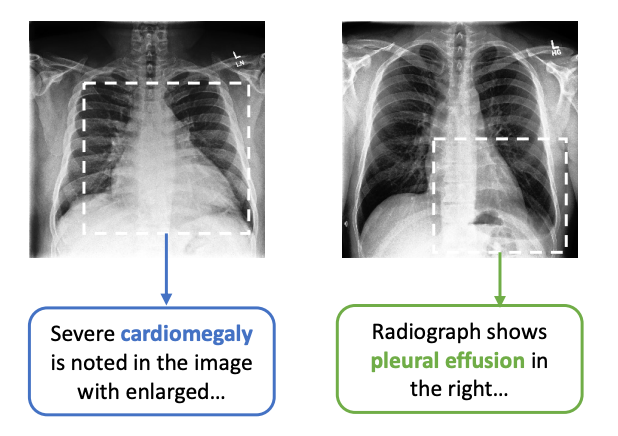
Figure 1: Two example chest X-ray images with different abnormality categories
ConVirt introduced a new method of pretraining medical image encoders with the paired text data (as in Figure 1) via a bidirectional contrastive objective between the two modalities. This method was domain-agnostic, and required no additional expert input.
However, ConVirt had been applied in the medical context. CLIP expanded this idea to general visual recognition. Thus, ConVirt directly inspired CLIP.
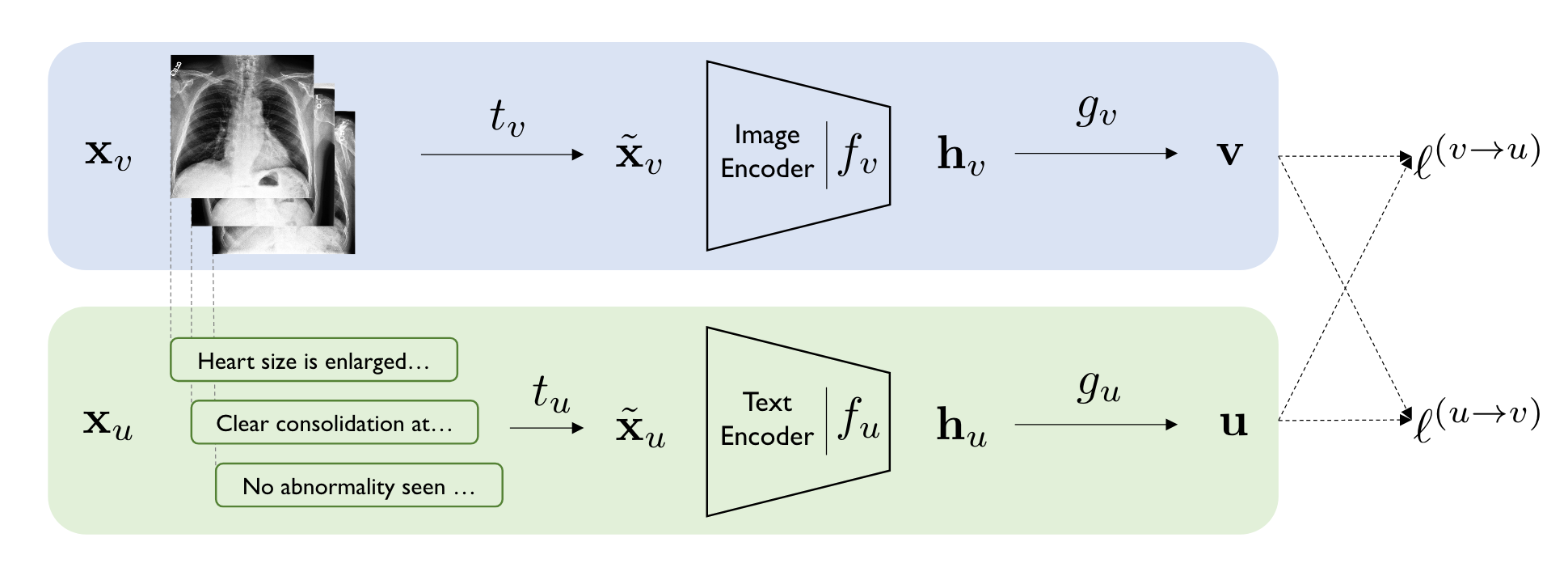
Figure 2: Overview of ConVirt
The figure above shows the overview of ConVirt, and as you’ll notice, CLIP is quite similar.
From the ConVirt paper:
ConVIRT has directly inspired subsequent studies such as the CLIP framework (Radford et al., 2021) and the ALIGN model (Jia et al., 2021), which showed that direct adaptations of ConVIRT-style pretraining at much larger scales lead to state-of-the-art general visual recognition capabilities.
4 Approach
At the core of our approach is the idea of learning perception from supervision contained in natural language. As discussed before, this is not at all a new idea.
Learning from natural language has several potential strengths over other training methods. Can you think of some?
- It’s much easier to scale natural language supervision compared to standard crowd-sourced labeling for image classification.
- Learning from natural language also has an important advantage over most unsupervised or self-supervised learning approaches in that it doesn’t “just” learn a representation but also connects that representation to language which enables flexible zero-shot transfer.
4.1 Summary with Pseudo-Code
In this section I will present the summary of CLIP architecture from the paper.
The overall approach has been presented in Figure 3 below. Can you notice the similarities to ConVirt in Figure 2?
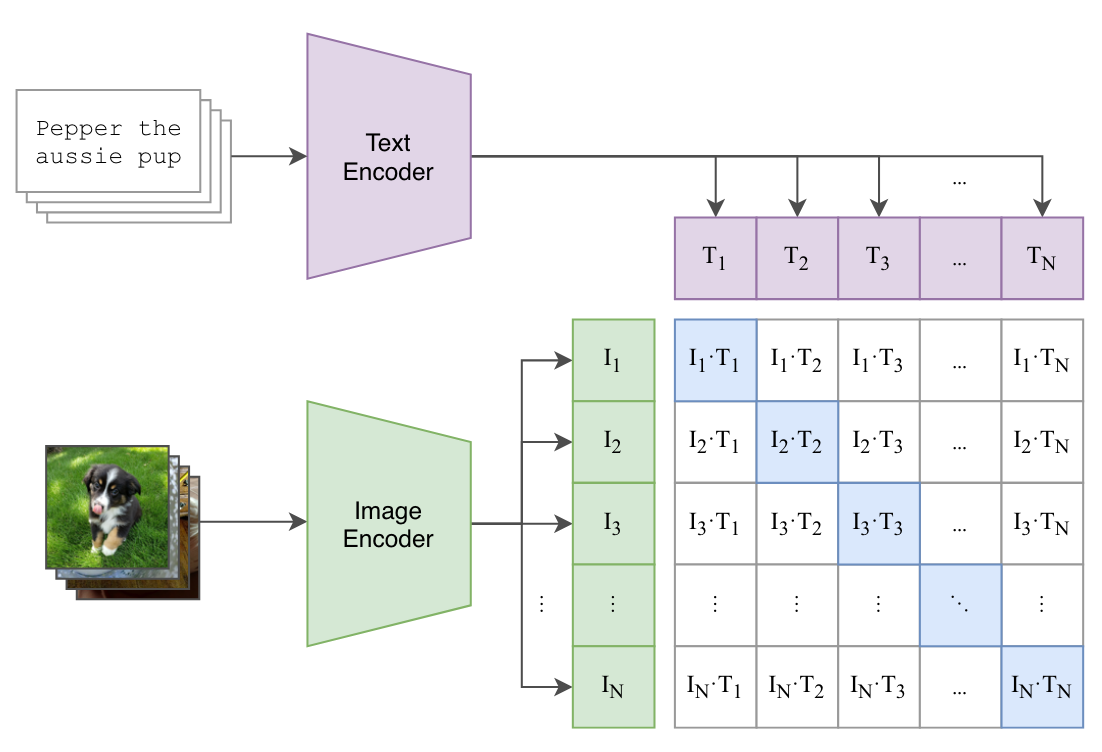
Figure 3: Summary of CLIP approach
CLIP Is architecture agnostic. You can use any models as visual and text encoders in Figure 3.
A team led by Ross Wightman, Cade Gordon, and Vaishaal Shankar have a repository OpenCLIP that is an open source implementation of CLIP and enables training for any vision models with contrastive image-text supervision.
Also, recently, Ross Wightman also announced a 847M param ConvNext model trained via CLIP training that achieves 79.43% ImageNet zero-shot eval. Astonishing, right?
The approach presented in Figure 3 has been summarised in pseudo code from paper:
Let’s look at what it all means with the help of Microsoft Excel.
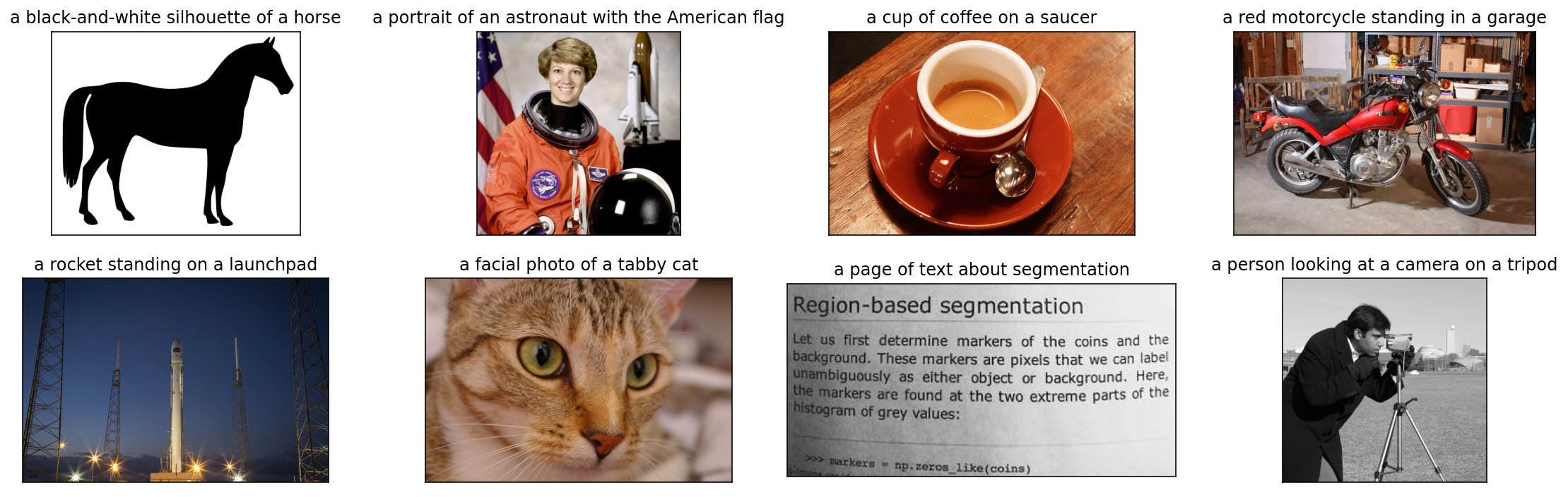
Figure 4: Illustration of contrastive loss
Let’s say we have 8 images with corresponding text descriptions as in Figure 4. CLIP presents a training framework to maximise the cosine similarity of text and image embeddings.
As from the pseudo-code, first we pass the images through image encoder and texts through text encoder respective to get image and text features.
Therefore in the above case, referencing to pseuo-code, \(n=8\) and \(d_i = 2048\) .
Similarly, referencing to pseudo-code, \(n=8\) and \(d_t=768\) .
Let’s just assume the embedding dimension \(d_e = 1024\) , now, as per psuedo-code, we can have two projection layers- \(W_i[d_i, d_e]\) and \(W_t[d_t, d_e]\) both for text and image features respectively.
Now that we have our projection layers, as per pseudo-code, we get our joint multimodal embeddings through dot product.
Now that we both our Image and Text embeddings, we can find cosine-similarity.
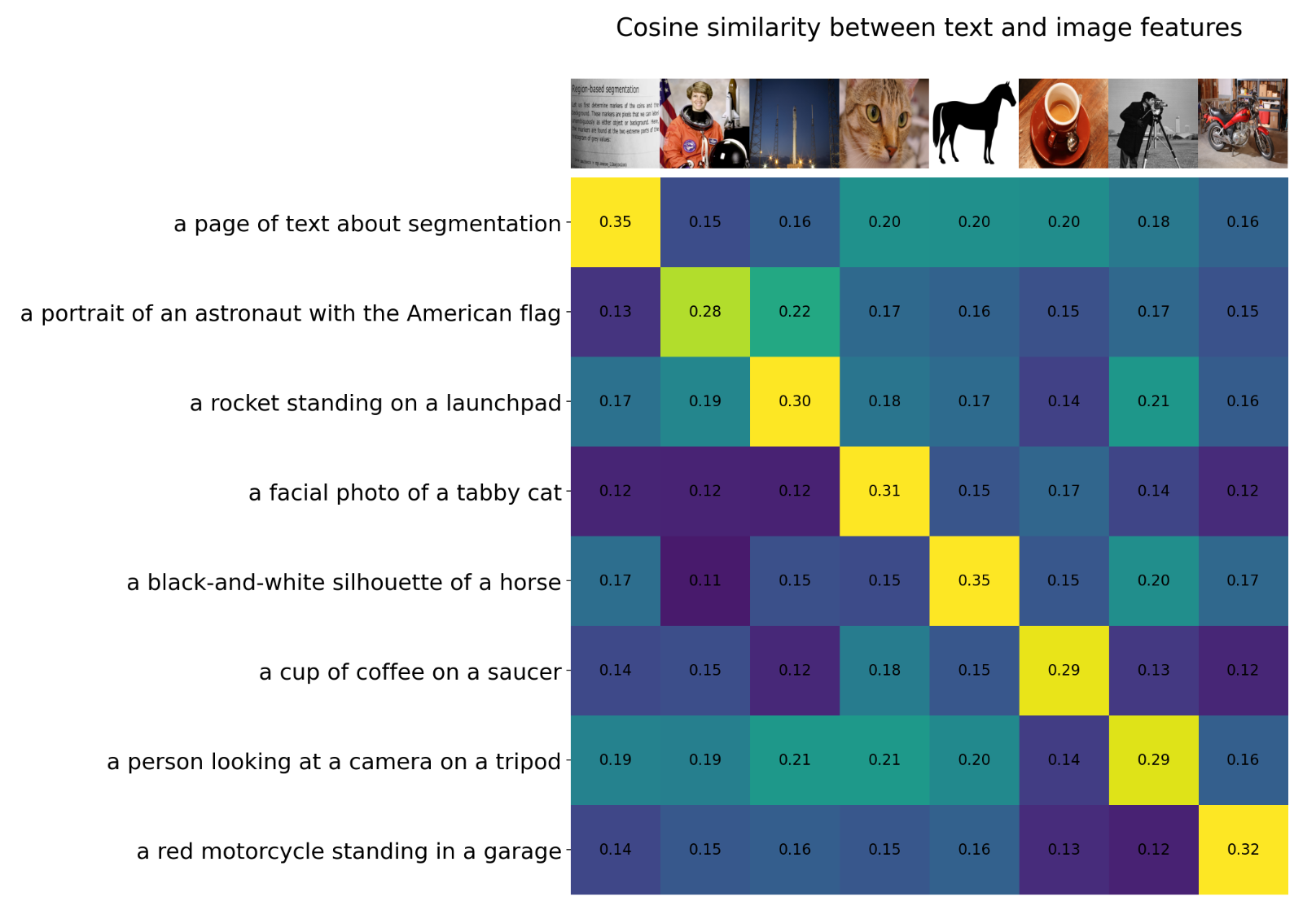
Figure 5: Cosine similarity between text and image features
We want the cosine similarity of real (text, image) pairs to be high (right diagonal), and everywhere else to be low.
So what loss function could we use in this case? The answer is in the pseudo-code.
When we do cross entropy loss with both axis=1 and axis=0, we are pushing logits to be high for the diagonal and low everywhere else. This is also referred to as Contrastive Loss. Thus, by doing this the CLIP model is able to learn visual features directly from text.
By training on a dataset of 400 million (image, text) pairs, the CLIP model is able to attain zero shot performance on ImageNet that is comparable to ResNet-50!
And that’s really all the magic behind CLIP.
5 Conclusion
As part of this blog post, we introduced the CLIP architecture to the reader. We saw how the CLIP approach is very similar to ConVirt with some very minor differences which we will discuss further in part-2 of the blog to be released next week.
In part-2, we will also be looking at the PyTorch code of CLIP, and the training code from OpenClip.
If you enjoyed reading, please feel free to subscribe to receive regular updates regarding new blog posts.
Для чего нужна модель clip

О нейросети
CLIP (Contrastive Language-Image Pre-Training) — это нейросеть, разработанная OpenAI для выполнения задач визуального, а также языкового понимания. Алгоритмы нацелены на понимание связи между текстом и изображениями.
Задачи: что умеет CLIP?
Инструмент имеет широкий диапазон применений, включая поиск похожих картинок, в том числе в социальных сетях, их классификацию, анализ контента визуальных медиа.
Сферы применения
Инструмент будет полезен дизайнерам, маркетологам, SMM-специалистам благодаря многочисленным возможностям для выполнения задач по созданию и формированию визуального ряда.
Как пользоваться?
Для обучения алгоритма используется большой набор данных и текстовых описаний. В ходе обучения нейросеть учится извлекать векторные представления исходного образца. В результате, ИИ может определить, соответствуют ли текст и изображение друг другу или нет.
Нейросети можно дать следующие типы заданий:
- классифицировать и найти похожие фото на основе содержания запросу;
- сгенерировать текстовое описание;
- найти картинку по тексту, сравнить картинки или выполнить автоматическую разметку.
Для использования сервиса потребуются знание языка Python и базовые навыки программирования.
Как использовать модель clip
Модель CLIP (Contrastive Language-Image Pre-training) является одной из самых инновационных разработок в области искусственного интеллекта. Она позволяет обучать компьютер распознавать и понимать содержание изображений и текстов на основе схожести и контрастности. Эта модель основывается на совместном предварительном обучении языковой и изображательной моделей, что открывает огромные возможности для решения различных задач в области компьютерного зрения и обработки естественного языка.
Преимущество модели CLIP заключается в ее способности использовать текстовые описания вместе с изображениями для обучения. Это позволяет ей понимать контекст изображений и устанавливать связи между ними и текстовыми данными. Такой подход существенно расширяет возможности машинного обучения и делает модель CLIP уникальной среди других аналогичных моделей.
С помощью модели CLIP можно решать множество задач, включая классификацию изображений, поиск похожих изображений, генерацию подписей к фотографиям и даже создание новых изображений на основе текстовых описаний. Все это делает модель CLIP мощным инструментом как для научных исследований, так и для практических применений в различных областях, включая компьютерное зрение, рекламу, медицину и многое другое.
Возможности модели clip в машинном обучении
Модель clip представляет собой инновационное решение в области машинного обучения, которое сочетает в себе методы компьютерного зрения и обработки естественного языка. Данная модель обладает значительными возможностями, которые делают ее востребованной в различных областях искусственного интеллекта.
1. Мультиязычность:
Модель clip способна работать с текстами и изображениями на различных языках, что позволяет использовать ее для межъязыковых задач. Она обучается на большом количестве данных на разных языках, что позволяет ей лучше понимать контекст и обрабатывать информацию на разных языках без необходимости дополнительной настройки.
2. Абстрактное понимание:
Модель clip не только распознает содержимое изображений и текстов, но и способна абстрагироваться от них и понимать более абстрактные концепции. Она может, например, анализировать не только конкретные объекты на фотографии, но и понимать, что фотография изображает прекрасный закат или печальный момент.
3. Связь текста и изображений:
Одной из основных возможностей модели clip является способность устанавливать связь между текстом и изображением. Она может оценивать тексты с точки зрения соответствия изображению и наоборот. Благодаря этому модель clip может быть использована для задач сопоставления текстов и изображений, отыскания связей между ними и визуального поиска информации.
4. Гибкость и адаптируемость:
Одним из важных преимуществ модели clip является ее гибкость и адаптируемость. Она может быть дообучена на новых данных и улучшена в конкретных задачах. Модель clip может быть приложена в множестве областей, таких как компьютерное зрение, обработка естественного языка, рекомендательные системы и т.д.
5. Высокая точность:
Современные исследования показывают, что модель clip достигает высоких показателей точности в широком спектре задач, таких как классификация изображений, определение похожих изображений, поиск по тексту и других. Ее точность является одной из лучших среди существующих моделей, что делает ее незаменимой в решении сложных и важных задач.
6. Простота в использовании:
Модель clip разработана с учетом не только своих возможностей, но и удобства использования. Она предоставляет простой интерфейс и легко интегрируется в различные системы. Благодаря этому, модель clip может быть применена не только исследователями и специалистами в области машинного обучения, но и разработчиками коммерческих приложений, упрощая процесс интеграции.
Модель clip представляет собой важный инструмент в задачах, связанных с обработкой текстов и изображений, визуальным поиском информации, классификацией и других задачах машинного обучения. Ее уникальные возможности позволяют использовать ее в различных областях искусственного интеллекта и значительно улучшить результаты работы таких систем.
Решение сложных задач компьютерного зрения
Модель CLIP (Contrastive Language-Image Pre-training) представляет собой инновационное решение для решения сложных задач компьютерного зрения. Она основана на идеях совместного обучения и проекции изображений и текстов, что позволяет модели понимать связь между ними и лучше работать с мультимодальными данными.
Одной из сложных задач, которые модель CLIP может решать, является классификация изображений. Благодаря обучению на большом количестве размеченных данных, модель может точно определять объекты на изображении и относить их к определенным категориям. Это полезно в таких областях, как медицина, автоматическое распознавание лиц, контроль качества и многое другое.
Кроме того, модель CLIP может использоваться для поиска по изображениям. Она способна находить похожие изображения и связанный с ними текстовый контент, что позволяет сократить время и усилия, затраченные на поиск нужной информации. С помощью этой модели можно эффективно работать с большими базами данных изображений и проводить анализ исследовательских данных.
Не менее важной задачей, которую модель CLIP может решать, является генерация описаний к изображениям. Благодаря обучению на большом количестве текстовых данных, модель способна автоматически создавать описание к изображению, а также делать выводы и формулировать суждения на основе визуальной информации. Это может быть полезно, например, для создания систем аннотирования изображений и генерации уникального контента.
В итоге, модель CLIP представляет собой мощный инструмент для решения широкого спектра сложных задач компьютерного зрения. Она сочетает в себе преимущества обучения с подкреплением и глубокого обучения, что позволяет ей эффективно работать с различными типами данных и проводить комплексный анализ мультимодальной информации. Применение модели CLIP может значительно улучшить качество и эффективность решения задач компьютерного зрения.
Повышение качества семантического поиска
Семантический поиск является одним из ключевых инструментов в современных системах информационного поиска. Он представляет собой метод поиска информации на основе смыслового содержания запроса пользователя. Однако, для достижения максимальной эффективности и точности поисковой системы, необходимо использовать соответствующие модели машинного обучения.
Одной из наиболее эффективных и широко используемых моделей машинного обучения для повышения качества семантического поиска является модель clip (Contrastive Language-Image Pretraining). Данная модель обучается с учителем на множестве мультимодальных данных, состоящих из пар изображений и текстовых описаний.
Преимуществом модели clip является то, что она способна извлекать семантическое представление для широкого спектра объектов, даже если для них нет разметки или они неизвестны. Это позволяет повысить качество семантического поиска и улучшить сопоставление между текстовыми запросами и изображениями.
Модель clip использует принцип контрастивного обучения, который заключается в сопоставлении пар изображений и текстовых описаний. Она обучается на огромном наборе пар изображений и текстовых описаний, где модель учится предсказывать, какое описание соответствует конкретному изображению, и наоборот. Таким образом, модель получает представления для изображений и текстовых описаний, которые учитывают их семантическое содержание и пригодны для семантического поиска.
При использовании модели clip в семантическом поиске происходит сопоставление текстовых запросов пользователя и изображений на основе их семантического содержания. Модель clip позволяет определить сходства и различия между запросами и изображениями, что позволяет более точно и эффективно находить соответствующую информацию в больших базах данных. Таким образом, использование модели clip позволяет повысить качество семантического поиска и обеспечить более релевантные результаты для пользователей.
Создание автономной системы распознавания объектов
Создание автономной системы распознавания объектов является одной из важнейших задач в области компьютерного зрения и машинного обучения. Такая система способна самостоятельно определить и идентифицировать объекты на изображениях или видео.
Для успешной реализации автономной системы распознавания объектов могут использоваться различные методы и алгоритмы, однако одним из наиболее эффективных и популярных подходов является использование модели CLIP (Contrastive Language-Image Pretraining).
Модель CLIP — это современная модель, разработанная командой OpenAI, которая предназначена для обучения машинного обучения на основе изображений и текста. Модель обучается на парах изображений и соответствующих текстовых описаний, что позволяет ей устанавливать связи между содержанием изображений и текстовых контекстом.
Преимущества использования модели CLIP для создания автономной системы распознавания объектов:
- Универсальность. Модель CLIP обладает значительной гибкостью и способна работать с различными типами данных, включая изображения, тексты и их сочетание.
- Обучение без учителя. Модель CLIP обучается путем максимизации сходства между изображением и текстом, что позволяет ей находить семантически связанные пары.
- Масштабируемость. Модель CLIP обучается на большом объеме данных, что позволяет ей обладать широкими возможностями распознавания объектов.
- Высокая точность. При использовании модели CLIP достигается высокая точность распознавания объектов, так как модель учитывает как визуальную, так и текстовую информацию.
Для создания автономной системы распознавания объектов на основе модели CLIP необходимо подготовить обучающий набор данных, включающий изображения и соответствующие им текстовые описания. Затем модель обучается на этих данных, что позволяет ей научиться распознавать и идентифицировать объекты на основе текстовых и визуальных контекстов.
Пример таблицы с объектами и соответствующими текстовыми описаниями
После обучения модель может быть использована для распознавания объектов на новых изображениях или в видеопотоке. Автономная система распознавания объектов, основанная на модели CLIP, может быть использована в различных областях, включая автономную навигацию роботов, видеонаблюдение, решение задач в медицине и многое другое.
В заключение, создание автономной системы распознавания объектов на основе модели CLIP является эффективным и универсальным подходом, который позволяет объединить визуальные и текстовые данные для более точного и гибкого распознавания объектов на изображениях и видео.
Улучшение процесса генерации текста и перевода
Использование модели CLIP в машинном обучении позволяет значительно улучшить процесс генерации текста и перевода, применяемый в различных приложениях и сервисах.
Модель CLIP, разработанная командой OpenAI, объединяет в себе преимущества глубокого обучения и сверточных нейронных сетей. Она обучена на большом наборе данных, что позволяет ей анализировать контекст и смысл изображений и текста, а также находить связи между ними.
Одной из ключевых функций модели CLIP является возможность генерирования текста на основе заданных изображений. Это полезно, например, в задачах описания и классификации изображений. Модель способна выдавать верные и содержательные описания, применяя свои знания и понимание взаимосвязей между изображениями и словами.
Кроме того, модель CLIP может быть использована и для задачи перевода. Она позволяет более точно и качественно переводить текст с одного языка на другой. Модель способна учесть не только лексическое значение отдельных слов, но и их смысловые связи и контекст, что делает ее перевод более естественным и точным.
Одним из преимуществ модели CLIP является ее универсальность. Она может быть применена в различных областях и с разными типами данных. Благодаря своим возможностям анализировать и понимать текст и изображения, модель способна подстраиваться под конкретные задачи и давать качественные результаты.
Таким образом, использование модели CLIP в машинном обучении позволяет улучшить процесс генерации текста и перевода, делая его более точным, содержательным и естественным. Это открывает новые возможности для различных приложений и сервисов, где требуется генерация текста на основе изображений и перевод с высокой точностью.
Вопрос-ответ
Для чего можно использовать модель CLIP в машинном обучении?
Модель CLIP может быть использована для решения различных задач в машинном обучении, таких как классификация изображений, векторизация изображений и текстов, поиск похожих изображений и многое другое. Благодаря своей универсальности и способности работать с разными видами данных, CLIP становится мощным инструментом в области машинного обучения.
Как работает модель CLIP?
Модель CLIP основана на комбинации нейронной сети обработки изображений и нейронной сети обработки текста. Она позволяет связать изображения и соответствующие им описания или заголовки, создавая векторные представления для каждого пары изображение-текст. Затем, используя эти векторные представления, CLIP может выполнять различные задачи, такие как классификация, поиск и сопоставление изображений и текстов.
В чем преимущество модели CLIP перед другими моделями в машинном обучении?
Одним из основных преимуществ модели CLIP является ее универсальность. Она может работать с разными типами данных — изображениями и текстами — без необходимости предварительного обучения на большом объеме данных. Кроме того, в отличие от других моделей, CLIP не требует разметки данных, так как она использует самонадзорную обучение, что делает ее более гибкой и удобной в использовании.
Каким образом модель CLIP помогает решать задачи в машинном обучении?
Модель CLIP создает векторные представления для изображений и текстов, что позволяет ей выполнять разнообразные задачи в машинном обучении. Например, она может классифицировать изображения и тексты, искать похожие изображения, сравнивать и сопоставлять изображения и тексты, а также выполнять другие операции, связанные с анализом и обработкой данных.